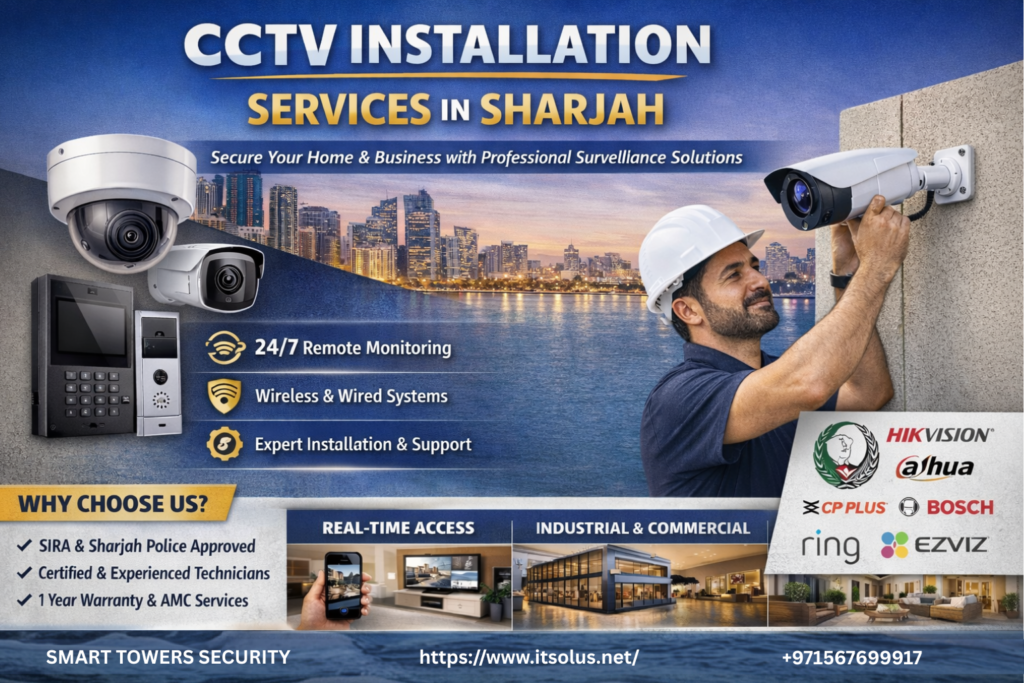
The Overlooked Gap Between Watching and Responding
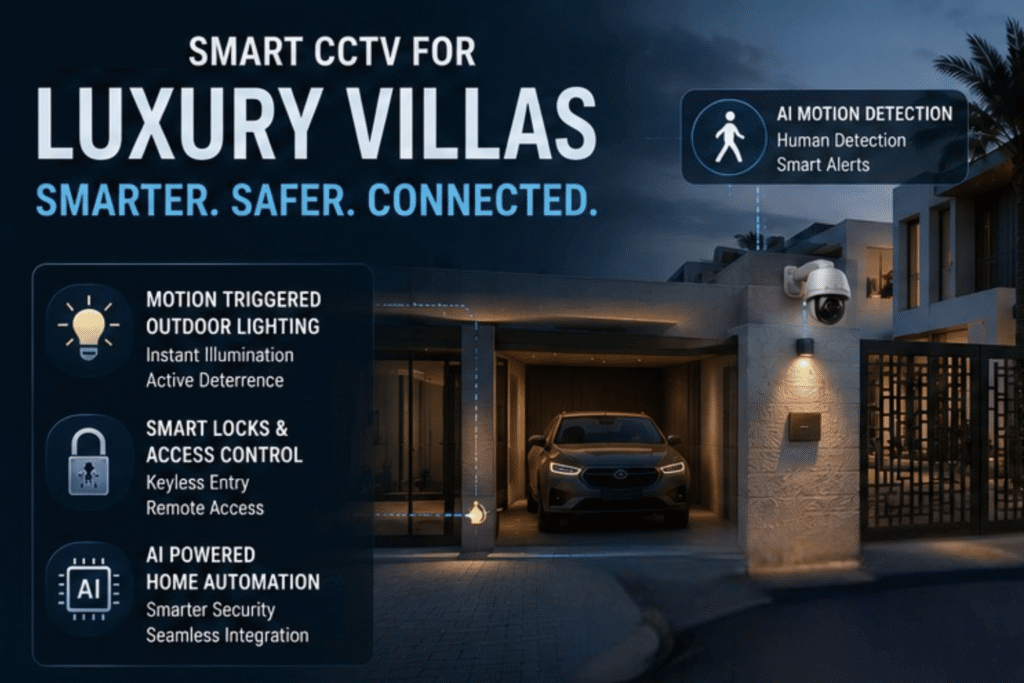
Most homeowners install CCTV and believe their job is done. But footage sitting on a DVR that nobody watches is just expensive wallpaper. The real shift happens when surveillance stops being passive and starts triggering actual responses — lights flipping on, doors locking, phones buzzing.
That gap between watching and responding is where smart home integration lives. And once you experience it firsthand — whether managing a villa in the suburbs or a high-rise apartment in Dubai — going back feels genuinely impossible. This isn’t about convenience; it’s about fundamentally rethinking how property security behaves.
Why Your CCTV and Smart Home Should Share a Brain
Consider what happens the moment a motion sensor detects movement at 2 AM near your front gate. In a traditional setup, footage records silently. In a connected ecosystem, the smart lights flood the area, your door locks engage, and an alert lands on your phone within seconds — all automatic.
This isn’t theoretical. Automation rules built inside platforms like Google Home or Apple HomeKit let cameras communicate with alarms, lighting, and smart locks. The result is a layered defense that responds faster to any potential threat than any human monitoring service realistically could.
Traditional CCTV vs. Smart Systems — The Honest Comparison
Traditional CCTV cameras built around closed-circuit architecture earn respect for one reason: they are stubbornly reliable. No Wi-Fi dependency means no lag, no dropped feeds, and near-zero susceptibility to network hacking. For budget-conscious deployments or sites with poor connectivity, this matters deeply.
Smart IP cameras countered that advantage with capabilities that reframe the entire value proposition. Facial recognition, night vision, two-way audio, and real-time alerts sent to your mobile device transform a recording tool into an active security participant. The trade-off is a higher initial cost and dependence on a stable internet connection.
What rarely gets discussed: the long-run economics often favor smart systems. When remote access eliminates the need for on-site physical monitoring staff, the cost-effective argument flips entirely. Especially relevant for UAE homeowners managing property while frequently travelling abroad.
Hardware Reality — What Integration Actually Requires
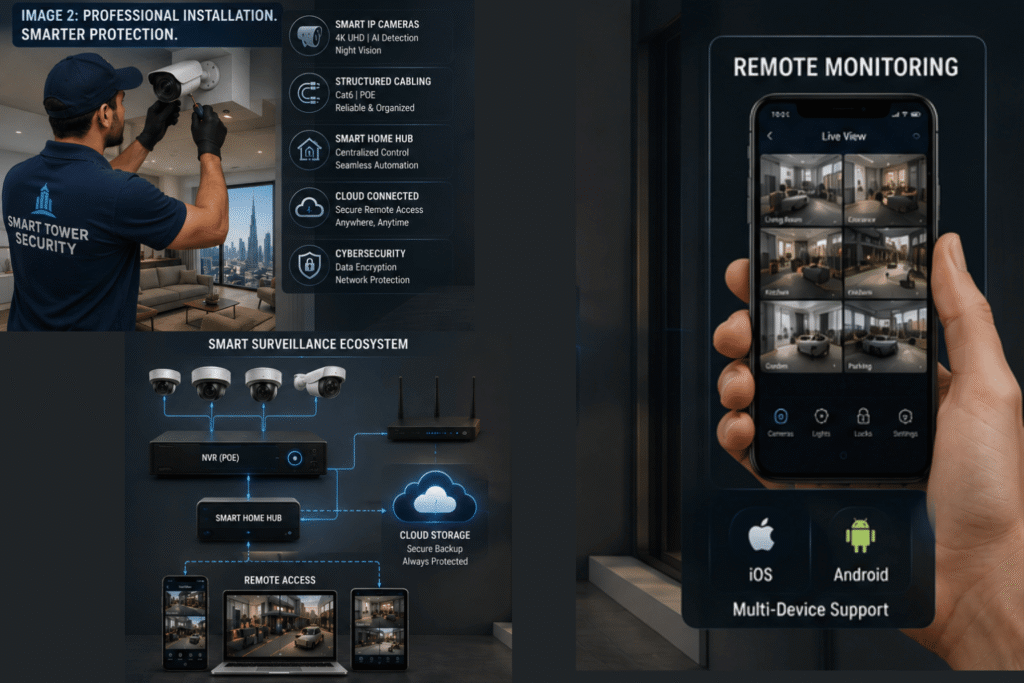
Not every camera on a shelf qualifies. For genuine smart home integration, look specifically for Wi-Fi-enabled or PoE IP cameras that support cloud storage, mobile apps, and named smart home platforms. Buying incompatible hardware first is the most expensive lesson in this space.
A smart hub — whether an Amazon Echo, Google Nest Hub, or SmartThings controller — acts as the central nervous system. It allows your CCTV to communicate with gadgets across the network: alarms, lighting, climate controls, and door locks. Without one, devices operate in isolated silos.
Often overlooked: structured cabling. Wi-Fi alone cannot sustain multiple simultaneous camera feeds in larger homes without degradation. Purpose-laid network cabling delivers the stable performance and strong connectivity that wireless simply cannot guarantee — particularly in multi-floor villas across the UAE.
Three Steps That Most Guides Skip the Detail On
| 1 |
Choose Based on Compatibility, Not PriceVerify platform compatibility before purchase. A camera that costs 20% less but doesn’t support your existing smart home ecosystem will cost more in replacement. Prioritise night vision, recording quality, and confirmed mobile access capability. |
| 2 |
Unify the Network — Ethernet FirstPlace all smart gadgets and cameras on a single Ethernet network where possible. Use structured cabling for critical feeds. In bigger homes, a dedicated VLAN for cameras isolates traffic and improves connectivity reliability across every indoor and outdoor device. |
| 3 |
Build Routines, Not Just ConnectionsLinking devices through an app or hub is just the start. The real value emerges when you define automation routines: hallway lights activating on motion detection, alarms triggering on zone breach. Test every scenario before relying on them. |
Why Dubai and the UAE Have Specific Demands
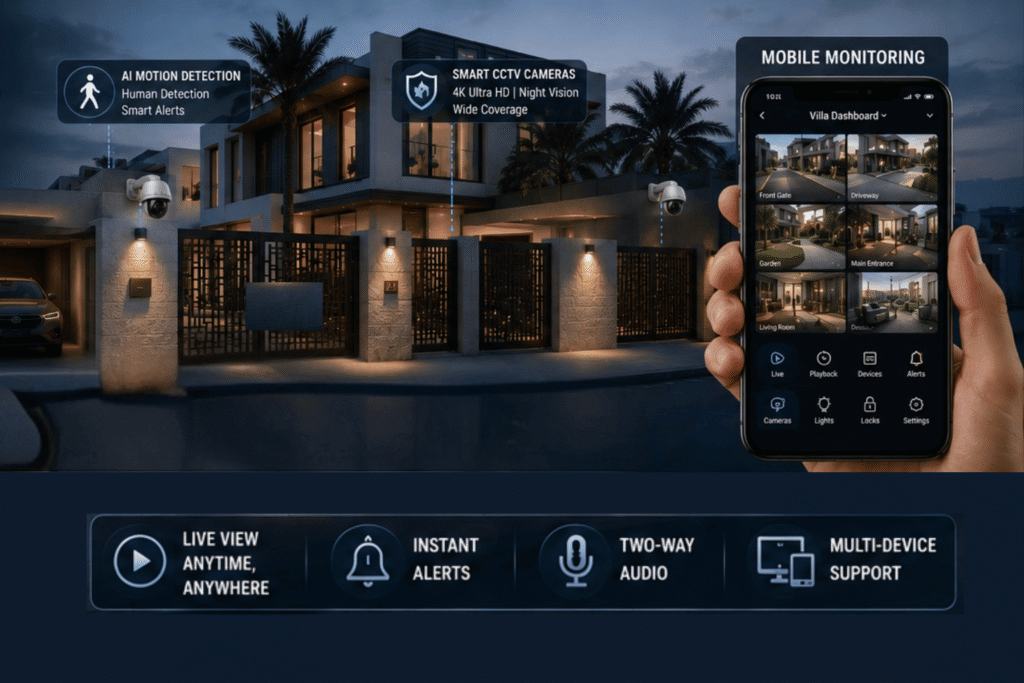
Living in the UAE introduces patterns that make smart CCTV integration more practical than anywhere else. Homeowners travel frequently — sometimes across continents — and still need real-time awareness of their property. Monitoring deliveries, tracking visitors, and checking on elderly members or kids remotely is not a luxury; it is routine.
Dubai’s urban landscape also imposes specific expectations. Security regulations, building management requirements, and the rise of smart-ready villas and high-end apartments mean integrated surveillance systems increasingly influence property value assessments. Buyers and tenants actively look for this infrastructure.
Privacy Risks and the Mistakes That Create Them
Every camera connected to the internet carries inherent exposure. Hacking attempts against poorly secured home networks are not hypothetical — they are routine. The mitigation is straightforward: strong passwords, scheduled firmware updates, and never connecting cameras through public Wi-Fi networks.
Common Mistakes to Avoid
| ✕ | Purchasing cameras that do not support smart integration — discovered only after installation. |
| ✕ | Relying entirely on Wi-Fi without structured cabling, causing camera feed instability. |
| ✕ | Ignoring app updates and firmware upgrades, leaving known vulnerabilities open. |
| ✕ | Failing to configure privacy controls — sharing footage access more broadly than intended. |
DIY Enthusiasm vs. Professional Execution
Consumer-grade setup guides make smart home CCTV integration look straightforward. In practice, compatibility issues between platforms, the complexity of proper network setup, and the risks of improperly terminated structured cabling catch most DIY attempts. What seems like a weekend project quietly extends into weeks.
Professional CCTV installation — particularly from SIRA-approved companies operating in the UAE — eliminates that uncertainty. Everything is tested under load, wiring complies with local standards, and the system is handed over actually working. For villas or anyone without prior network setup experience, professional execution isn’t optional — it’s rational.
Where This Technology Is Heading
The future of CCTV in Dubai and the broader UAE isn’t about more cameras — it’s about smarter decisions from existing ones. AI-driven anomaly detection, predictive alerts, and deeper integration with city-level security infrastructure are already being piloted. Modern homeowners who invest in smart systems now are building on architecture that will absorb these advances naturally.
The systems being installed today are the foundations of security ecosystems that will be significantly more capable in 36 months. Choosing the right CCTV platform isn’t just about today’s safety — it’s about ensuring your infrastructure can evolve without requiring a complete replacement every few years.
Feature Comparison: Traditional vs. Smart CCTV
| Feature | Traditional CCTV | Smart CCTV |
| Remote Access | ✕ No | ✓ Yes |
| Motion Detection Alerts | ✕ Limited | ✓ Real-Time |
| Smart Home Integration | ✕ No | ✓ Full |
| Works Without Internet | ✓ Yes | ✕ Requires Wi-Fi |
| Upfront Cost | ✓ Lower | ✕ Higher |
| Long-Run Cost-Effectiveness | ✕ Moderate | ✓ Better ROI |
| Night Vision / Facial Recognition | ✕ Basic | ✓ Advanced |
| Professional Setup Required | ✓ Optional | ✕ Recommended |
Frequently Asked Questions
| Q1. Are smart home CCTV systems worth the extra cost in Dubai? |
| For UAE homeowners who travel frequently or manage multiple properties, the answer is almost always yes. Enhanced security features, remote access, and the ability to respond to alerts in real time justify the investment — particularly in a city moving toward fully smart infrastructure. |
| Q2. Can traditional CCTV systems work without the internet? |
| Yes. Traditional CCTV operates on a closed circuit, with footage stored directly to a DVR. No internet dependency means no exposure to network-based hacking — though it equally means no remote access or smart automation capability. |
| Q3. How can I protect my smart CCTV from hacking? |
| Use strong passwords on every device and your router. Schedule regular firmware updates — most vulnerabilities are patched within weeks of discovery but only matter if you install the update. Avoid connecting cameras via public Wi-Fi, and segment your camera network using a dedicated VLAN where possible. |
| Q4. Is it possible to upgrade a traditional CCTV system to a smart system? |
| Partially. With additional equipment — IP encoders, smart hubs, and compatible components — some traditional systems can be modified to include basic smart features. However, full integration typically requires replacing analogue cameras with Wi-Fi-enabled or PoE models. |
| Q5. Which is better for Dubai apartments — traditional or smart CCTV? |
| Smart CCTV systems are far more suitable for apartment dwellers. The absence of large outdoor areas makes remote access, mobile alerts, and visitor-monitoring features significantly more relevant than the closed-circuit reliability that benefits larger villa or commercial deployments. |