CCTV Systems for Warehouses and Logistics
Warehouses are the operational backbone of global supply chains. From e-commerce fulfillment centers to heavy manufacturing logistics hubs, these facilities concentrate enormous value under one roof — yet they face relentless threats: internal theft, inventory shrinkage, unauthorized access, and operational blind spots that erode profitability without anyone noticing.
Across UAE distribution corridors — Dubai, Sharjah, and Ajman — SIRA-certified surveillance has shifted from optional to mandatory. A professionally installed warehouse CCTV system doesn’t just record footage; it fundamentally reengineers how logistics operators govern accountability, safety compliance, and incident response across every operational zone.
Why Warehouse Security Is a Business-Critical Investment
The numbers tell a stark story. Internal pilferage, vendor cargo disputes, and loading dock incidents drain margins daily. What changes when 24/7 CCTV monitoring is deployed properly is not just loss prevention — it’s the entire culture of accountability within a distribution center.
Regulatory pressure adds another dimension. Workplace safety violations, forklift hazard zones, and hazardous material handling areas all fall under inspection frameworks that increasingly require evidential video footage. A facility without compliant security cameras is exposed to insurance denials and liability claims.
What Is a SIRA-Certified CCTV System?
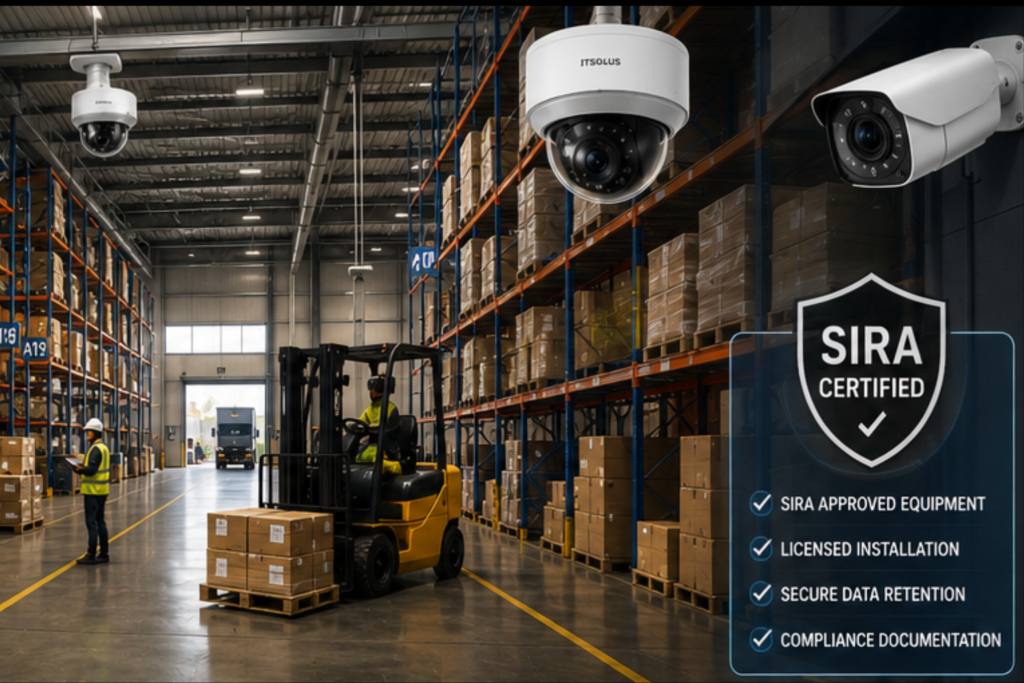
SIRA (Security Industry Regulatory Agency) is Dubai’s official body regulating private surveillance infrastructure. For any commercial warehouse or industrial storage facility, certification guarantees that hardware quality, installation methodology, and video data retention meet government-mandated benchmarks — ensuring footage holds up as legally admissible evidence.
A certified deployment requires licensed installation technicians, SIRA-approved camera hardware, strategic placement mapping, secure backup options, and full compliance documentation for regulatory inspections. Operating uncertified systems exposes businesses to fines and delays in business license renewals — risks no serious logistics operation should accept.
Benefits of SIRA-Compliant Warehouse Surveillance
A certified surveillance system in a warehouse doesn’t just watch — it audits. Remote monitoring via mobile and desktop dashboards gives managers real-time operational visibility regardless of physical location. Live feed access from loading bays to cold storage zones removes the blind faith that once defined off-site management.
Real-time alerts triggered by motion detection algorithms compress incident response from hours to seconds. When an intrusion alarm fires near a restricted inventory zone, the security team receives an automated notification simultaneously — enabling faster human intervention. That’s the operational difference smart surveillance creates.
What a Complete Warehouse CCTV Solution Includes
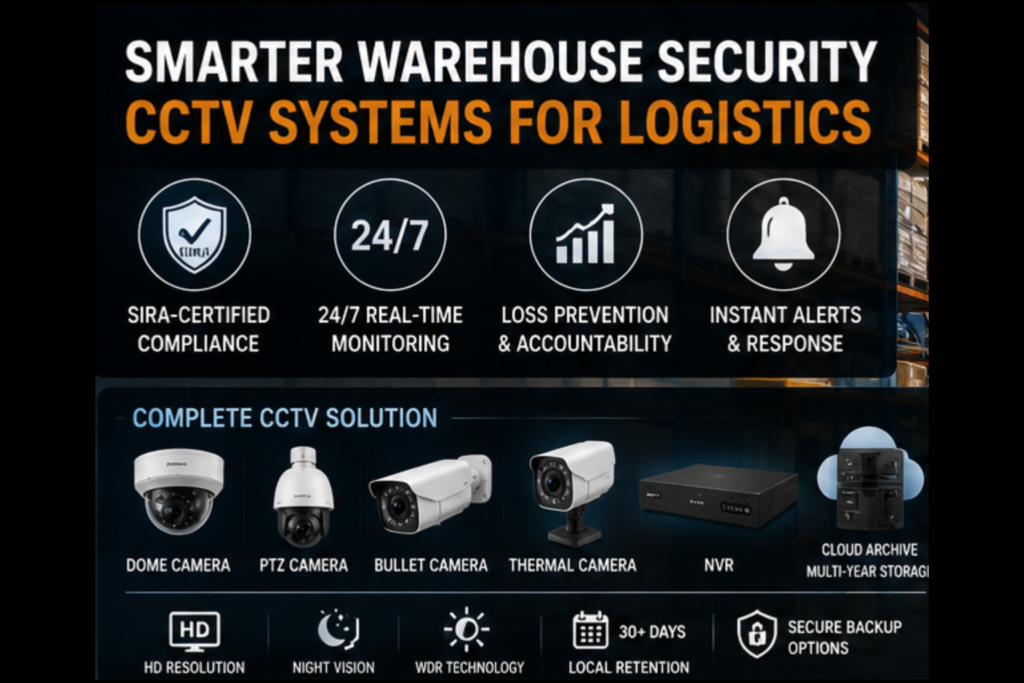
No two warehouses share identical floor layouts, ceiling heights, or ambient lighting profiles. This is why serious CCTV installation begins with an on-site facility survey. A proper multi-camera architecture combines dome cameras, PTZ cameras, bullet cameras, and thermal imaging units across all risk zones.
Network Video Recorders (NVRs) are sized for local retention of 30 days minimum, while cloud-based archival systems extend records to multi-year searchable archives. HD resolution, infrared night vision, and Wide Dynamic Range (WDR) technology ensure that every frame of warehouse video surveillance remains actionable regardless of lighting conditions.
Perimeter Protection and Access Control
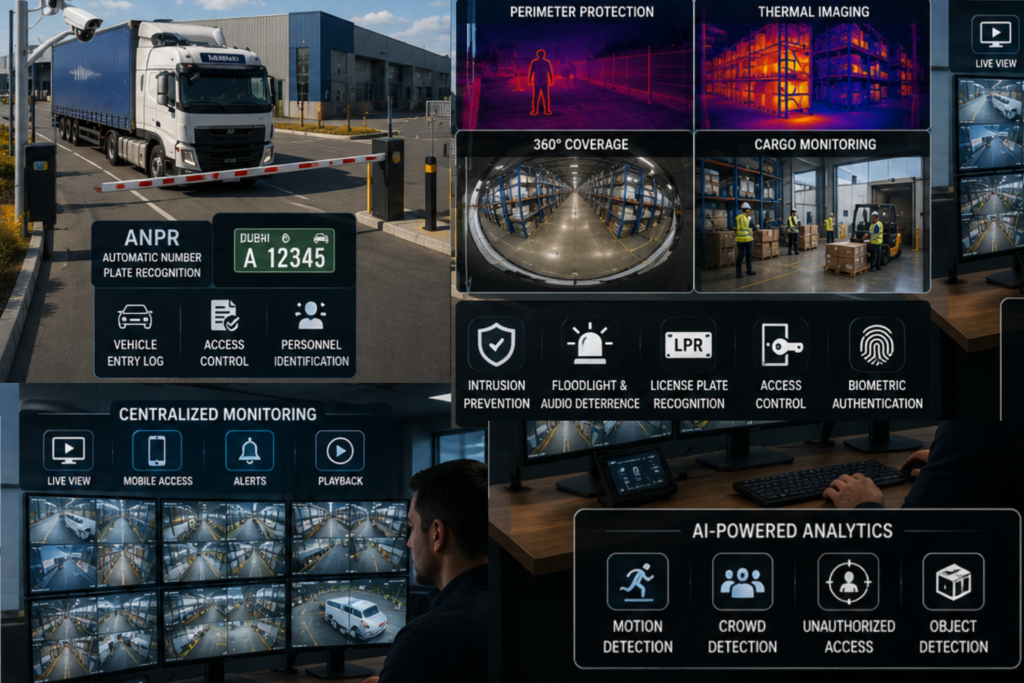
The perimeter is where breaches begin. Smart intrusion prevention systems using thermal camera arrays and active deterrence technology detect unauthorized movement well before a physical breach completes. Floodlight activation, audio warnings, and instant alarm triggers can all be automated — making the perimeter respond faster than any human guard.
ANPR (Automatic Number Plate Recognition) technology logs every vehicle entering and exiting the facility without manual intervention. Paired with deep-learning access control algorithms, personnel identification accuracy improves dramatically — eliminating tailgating risk at entry checkpoints while generating a tamper-resistant movement log across the entire site.
Cargo Monitoring and Temperature-Controlled Surveillance
Cold storage and climate-controlled bays present surveillance challenges standard IP cameras cannot meet. Thermal imaging CCTV thrives precisely where conventional lenses fail — detecting abnormal temperature variances and early fire hazard signatures invisible to the naked eye, often before facility sensors trigger independently.
For dense racking environments, 360° panoramic cameras eliminate the blind spots that plague fixed-angle setups. Backlight clarity technology cuts through glare from high-bay lighting. The result: every cargo movement — inbound shipment, outbound delivery, or internal transfer — is captured with evidential precision.
CCTV Integrations That Multiply Warehouse Security
A standalone surveillance system is a foundation — not a ceiling. Connecting CCTV cameras with alarm systems means every motion trigger simultaneously alerts the centralized monitoring dashboard and on-site responders. Automated incident workflows replace delayed manual processes, compressing every reaction cycle.
Layering in access control systems, biometric attendance, and Public Address (PA) systems creates a unified security management ecosystem. When an unauthorized entry attempt occurs in a restricted zone, the access panel, CCTV alert, and PA broadcast all fire in sequence — without any single operator having to coordinate it manually.
How to Choose the Right CCTV Installer for Your Warehouse
A credible CCTV installation company for warehouse environments must carry a valid SIRA license, demonstrate a verifiable portfolio of industrial surveillance projects, and provide genuine references from logistics facilities of comparable scale. Generic commercial installations don’t translate — warehouses demand specialized knowledge of IP-rated hardware, structured network cabling, and operational workflow mapping.
Evaluate also for post-deployment support: SIRA audit assistance, system scalability for future LPR upgrades or AI-powered video analytics additions, and 24/7 remote technician access. The cheapest installer rarely accounts for the hidden cost of downtime, compliance failures, or a system that cannot grow alongside your distribution operation.
Frequently Asked Questions
FAQ 01
Q: Which cameras work best in warehouse environments?
An optimized warehouse CCTV architecture typically combines IP cameras with infrared night vision for general coverage, dome cameras for aisle monitoring, PTZ cameras for large open zones, and thermal imaging cameras for cold storage — each selected based on ceiling height, risk profile, and lighting conditions.
FAQ 02
Q: Can warehouse CCTV function in complete darkness?
Yes. Thermal imaging sensors and advanced infrared technology maintain full video surveillance capability in zero-light conditions. This makes them essential for overnight logistics monitoring, after-hours perimeter security, and refrigerated storage zones where standard lighting is deliberately minimized to reduce energy costs.
FAQ 03
Q: How long is warehouse CCTV footage retained?
NVR-based storage typically supports 30-day local retention, while cloud archive systems extend records to multiple years — fully searchable by date, time, camera, and incident trigger. Retention schedules must align with your SIRA compliance policy and any operational audit requirements specific to your industry vertical.
FAQ 04
Q: Does CCTV integrate with other warehouse management systems?
Modern warehouse surveillance platforms integrate with access control, alarm systems, biometric attendance, and PA infrastructure. Creating a unified security management platform. Advanced systems also offer AI-powered video analytics, flagging abnormal behavior patterns, crowd accumulation, and unauthorized zone entry automatically, without manual review.