Introduction
Dubai’s skyline demands protection as fierce as its ambition. Every villa, apartment, and corporate office sits within a city where modern security challenges quietly coexist with opportunity. Choosing a reliable CCTV system isn’t reactive, it’s the sharpest proactive decision any property owner makes.
What separates secured assets from vulnerable ones isn’t luck, its surveillance strategy. Across Sharjah, Ajman, and beyond, residential and commercial spaces increasingly treat CCTV installation as foundational infrastructure, not an afterthought, delivering genuine peace of mind with every recorded frame.
Why CCTV Installation Is Important in Dubai
Security cameras do something no manual system can. They eliminate blind judgment. In Dubai, where tall towers, luxurious homes, and busy offices create dense human activity, crime prevention isn’t about deterrence alone. It’s about accountability, data, and smart decisions made before incidents escalate.
Experienced practitioners know workplace safety and loss prevention aren’t separate goals. They share the same surveillance infrastructure. Businesses leveraging real-time monitoring gain a competitive edge: fewer workplace incidents, stronger risk management, and insurance benefits that quietly reward proactive investment in CCTV protection.
Types of CCTV Systems Available
-
Analog CCTV Systems
Most security professionals rarely lead with this admission: analog CCTV systems still earn their place in budget-friendly residential and small setups where operational simplicity outweighs resolution demands. Running footage through a DVR, a digital video recorder over UTP cables or wired connections in baseband format, these traditional systems deliver dependable recording without network dependencies.
What the entry-level security market often overlooks is that HD analog has quietly closed much of the gap with its modern counterparts. Scalable, compatible with legacy devices and older formats, and capable of 720p output, these cost-effective cameras still anchor commercial and standard surveillance deployments where performance and upgrade paths matter more than cutting-edge specs.
-
IP CCTV Cameras
Most installers push resolution first, but seasoned professionals know IP cameras earn their place through network-level intelligence, not just high-definition clarity. In UAE deployments across villas, offices, and warehouses, what separates a good setup from a great one is how cleanly each camera feeds digital signals into a unified NVR infrastructure without choking bandwidth.
What rarely gets discussed: PoE wiring isn’t just a convenience, it’s a discipline. A single Ethernet cable handles both power and data, which forces installers to think about cable runs, connectivity, and network configuration before a single bracket touches the wall. That pre-planning is where advanced analytics, motion detection, and remote monitoring via mobile apps actually begin, not at the screen.
-
Wireless CCTV Systems
Wireless setups get underestimated in serious security conversations, yet they’re often the sharpest smart choice for apartments, small offices, and temporary constructions where cabling is impractical. The real advantage isn’t just easy installation, it’s flexibility: cameras can be repositioned as surveillance needs shift without rewiring entire systems.
WIFI cameras today carry two-way communication, motion detection, secure local storage, and full cloud storage access — all manageable through a single mobile app that integrates with smart home ecosystems. For plug-and-play setups delivering real-time alerts and HD video with night vision, the gap between wireless systems and wired ones has quietly closed.
CCTV Installation for Homes in Dubai
Most homeowners treat home security as an afterthought — until something happens. Having worked across residential projects in the UAE, the shift is clear: surveillance solutions are no longer reactive; they’re foundational. Families now demand round-the-clock monitoring as part of modern living, not as a luxury.
What surprises most clients isn’t the advanced technology — it’s how seamlessly it integrates with home automation. From mobile apps on smartphones to alerts triggered by motion-activated recording, today’s systems address unique security needs without disrupting daily routines. Customized, budget-conscious packages mean even modest homes benefit from always-on, connected infrastructure.
I’ll now write content for the CCTV Installation for Businesses subheadings using the provided words database, following all your structural and formatting rules.
CCTV Installation for Businesses
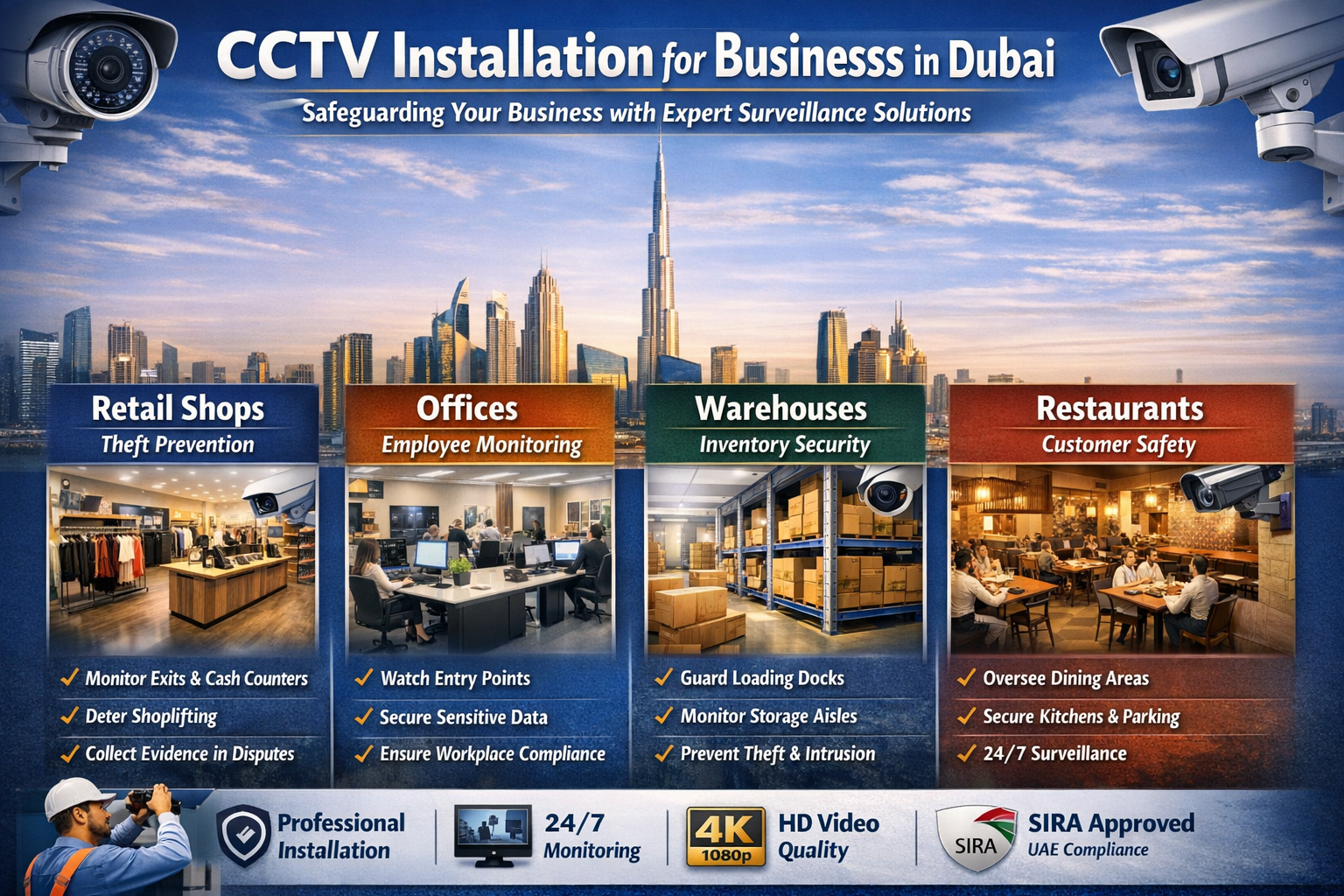
Retail Shops → Theft Prevention
Most retail owners discover their surveillance gaps only after a loss, that’s the wrong time to act. Strategic placement of security cameras near exit points and billing counters doesn’t just deter theft; it reshapes rational thinking among potential shoplifters before any criminal activity occurs.
Footage from retail environments serves dual purposes: crime deterrent through visible presence of cameras, and evidence collection during disputes. Experienced installers know that tailored camera angles around high-value shelves reduce property damage and vandalism far more effectively than generic surveillance solutions ever could.
Offices → Employee Monitoring
Office surveillance isn’t about distrust, it’s a management tool that reinforces safety standards and compliance across operations. Properly installed recording systems near entry points and server rooms protect assets, staff, and sensitive client data simultaneously without disrupting operational productivity.
From 24/7 lobby monitoring to access-controlled zones, modern security system setups in offices address modern security challenges proactively. With mobile apps and real-time alerts, managers gain visibility into employees, visitors, and clients, turning passive infrastructure into an active, effective oversight layer.
Warehouses → Inventory Security
Warehouses housing high-volume inventory face compounded risks, illegal entry, housebreaking, and theft often go undetected for hours. A proactive solutions-based approach using industrial-grade cameras with round-the-clock monitoring closes those blind spots before intruders exploit them.
What sets professional warehouse installs apart is understanding operations flow. Cameras positioned along loading docks, storage aisles, and public spaces near entry gates deliver valuable evidence during incidents — turning raw footage into a security landscape that organizations and businesses can actually rely on for crime deterrence.
Restaurants → Customer Safety
Restaurants balancing customers, staff, and compliance obligations benefit enormously from smart solutions that cover dining areas, kitchens, and parking zones. Visible security cameras reduce violent crime risks while reinforcing a culture where safety is felt, not just enforced through regulations.
Beyond burglary prevention, restaurant surveillance builds trust. Residents and repeat clients return to spaces where property feels secure. Integrated recording systems with motion-activated recording and 24/7 coverage help thriving businesses meet safety standards while providing evidence for internal disputes or insurance requirements.
Key Factors to Consider Before Installation
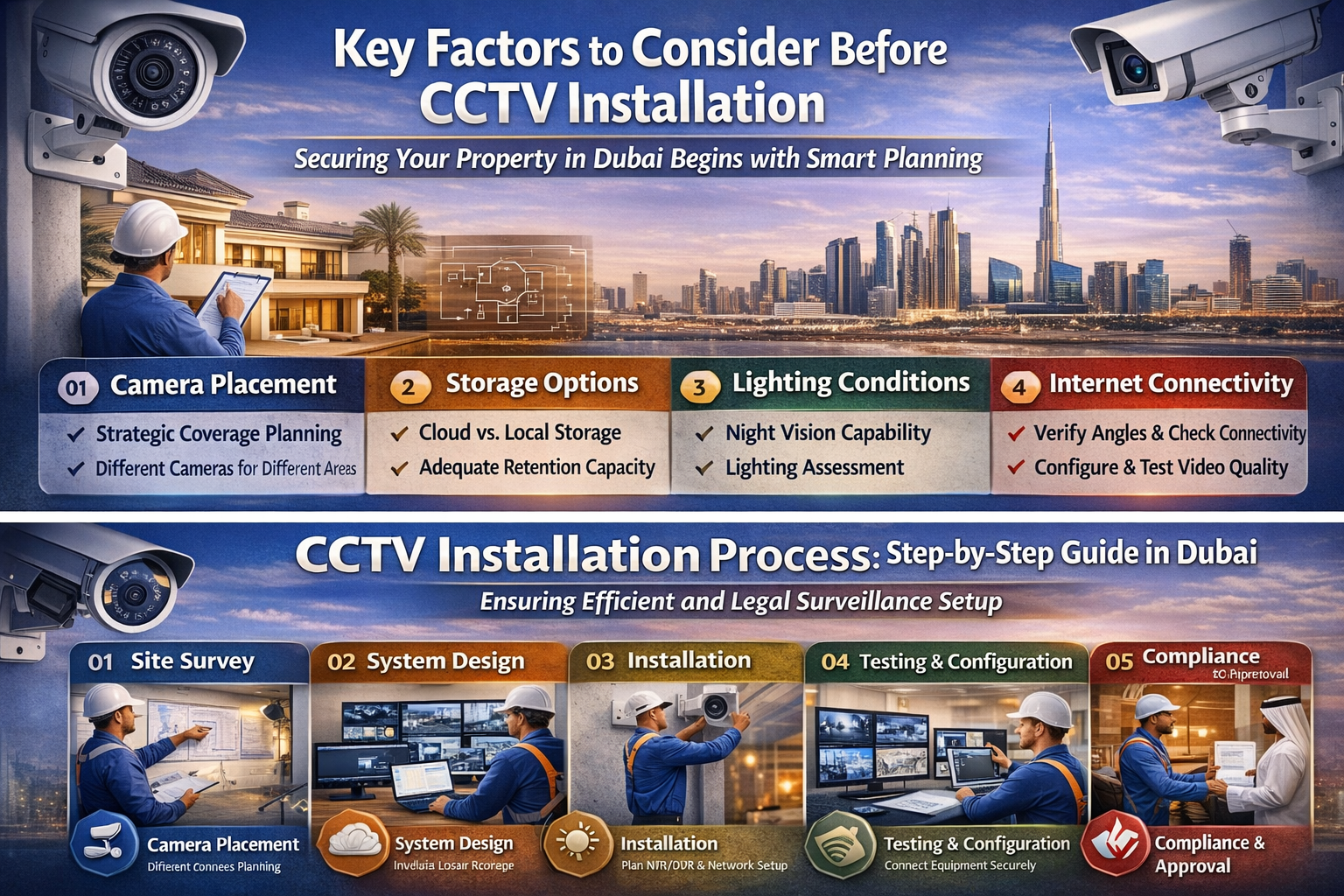
1. Camera Placement
Most installers think about coverage after the equipment arrives — that’s already too late. Strategic placement begins at the site survey stage, where blind spots, angles, and entry points are mapped against the actual property layout. In my experience working across residential and commercial setups, the difference between a system that performs and one that just exists comes down to whether indoor and outdoor zones were assessed for optimal coverage before a single bracket was mounted.
What most guides won’t tell you: mounting height matters as much as direction. Cameras fixed between 8 to 10 feet above ground capture facial recognition-grade detail without distortion. Parking areas, driveways, perimeter lines, and building entrances each demand a different camera type — a dome camera won’t serve a long driveway the way a bullet camera does. Plan the angles first, install second.
2. Storage Options
Cloud storage and local storage solve different problems, and choosing between them isn’t about preference — it’s about retention priorities. A DVR or NVR setup with sufficient hard drives handles recording reliably without subscription plans, but it creates a single point of failure. Cloud storage adds backup redundancy and supports remote viewing from smartphones anywhere in the world, provided internet connectivity holds.
The practical question is storage capacity against footage volume. Systems running HD or 4K resolution generate far more data than 720p setups. Most compliance frameworks under SIRA require footage held between 15 days and 90 days depending on the site classification. Designing storage around the minimum is a mistake — factor in scalable expansion from the start, whether through additional hard drives or subscription plans tied to cloud infrastructure.
3. Lighting Conditions
Night vision capability is often treated as a bonus feature rather than a baseline requirement — that framing is outdated. In the UAE heat, where dust and extreme temperatures reduce ambient light unpredictably, cameras without strong IR performance create blind spots after dark that defeat the entire surveillance purpose. HD cameras and IP cameras with built-in night vision should be the default for any outdoor zone, not an upgrade tier.
Indoor lighting conditions present a different challenge: overexposed entrances near hallways or elevators can wash out facial recognition detail entirely. Motion detection calibrated without accounting for light shifts triggers excessive alerts and degrades recording functionality over time. The fix is positioning cameras where natural and artificial light sources complement rather than compete with the lens — something only a proper site survey reveals before installation.
4. Internet Connectivity
Here’s a counterintuitive reality: IP cameras can record entirely without the internet — but the moment remote access becomes a requirement, network configuration becomes as critical as the cameras themselves. WIFI dependency without a wired network backbone creates latency that renders live footage and real-time streaming unreliable, particularly in commercial sites running 16 cameras or more simultaneously.
Bandwidth is the variable most clients overlook during system configuration. A mobile app pulling live feeds across 4K cameras over a congested wireless network will underperform a wired setup running 1080p every time. For residential properties, a stable WIFI router with dedicated IP assignment per camera is workable. For warehouses, offices, or any industrial space, structured cabling with PoE switches is the only configuration that guarantees seamless performance under continuous 24/7 monitoring demand.
CCTV Installation in Dubai: Complete Guide for Homes & Businesses
CCTV Installation Process (Step-by-Step)
Most installers rush the site survey — that’s where projects fail before a single cable gets run. Experienced certified technicians read a space differently: they trace blind spots, map entry points, and assess power management needs before recommending any system configuration. This pre-work defines everything downstream.
What separates an average setup from a reliable setup is the testing phase. After wiring is complete and cameras are physically mounted, knowledgeable engineers verify camera angles, confirm connectivity, and stress-test recording functionality. Performance is validated on day one — not discovered broken six months later.
Legal Requirements for CCTV in UAE
SIRA doesn’t just approve equipment — it governs camera placements, mandates backup power supply, and enforces technical standards across Dubai, Sharjah, and Ajman. Operating without CCTV approval tied to your business license exposes you to penalties and fines that can freeze commercial operations overnight.
Certified installers submit a site layout to government authorities alongside a formal application. Authorized locations, approved equipment, and signage requirements aren’t optional checkboxes — ADMCC and Dubai Police audit compliance actively. Non-compliance costs more than the security permits ever would.
Common CCTV Installation Mistakes to Avoid
Installers who skip strategic placement planning almost always create connectivity issues and poorly positioned cameras that generate blind spots rather than optimal coverage. PTZ cameras aimed at high-traffic areas without accounting for exits and sensitive zones miss the entire behavioral picture that makes footage actionable.
Wireless cameras in outdoor patios or gardens without IP66 or IP67 ratings fail under rain and harsh environmental conditions — particularly in UAE heat. Similarly, placing covert cameras or thermal cameras without SIRA alignment creates legal requirements violations. Full coverage across hallways, elevators, gates, and living areas demands structured 360 degree planning, not improvisation.
Maintenance Tips for CCTV Systems
Annual maintenance isn’t a formality — it’s how long-term performance survives downtime pressure. Routine cleaning of IP cameras, DVR, and NVR units, paired with firmware updates and password security checks, keeps recording functionality intact. Monthly or quarterly inspections catch wiring and connections issues before they become complex repairs.
Cloud storage and local storage setups both need data backups reviewed during preventive maintenance cycles. Storage capacity, system configuration, and software updates that address vulnerabilities directly impact retrieval speed when evidence from incidents is urgently needed. A maintenance contract covering NVR, DVR, and HD cameras eliminates guesswork from troubleshooting.
Why Choose Professional CCTV Installation?
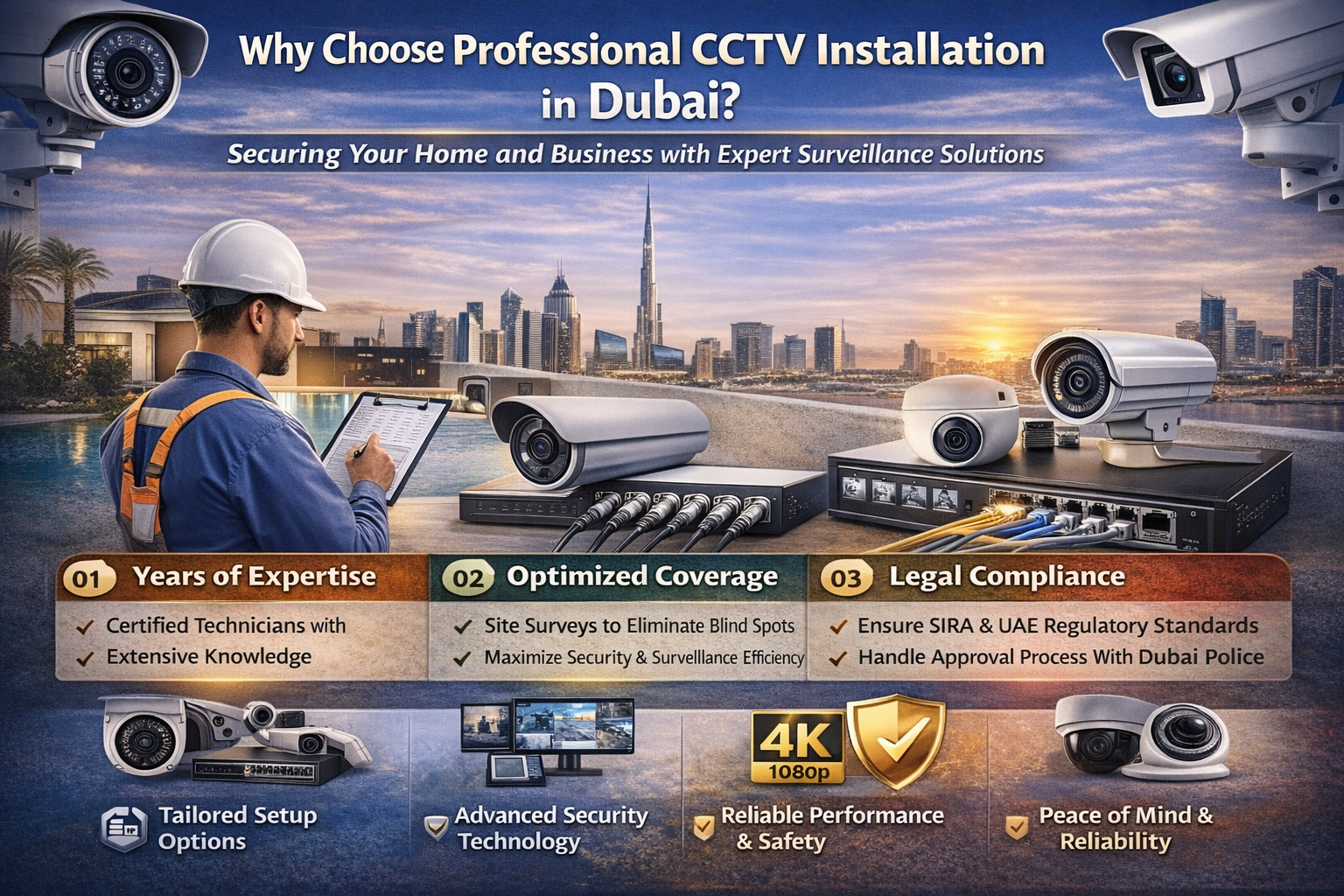
Most property owners underestimate one thing: a retail shop with four cameras placed wrong offers less surveillance technology protection than one with two cameras placed right. Professional installers bring years of expertise and understand key considerations that self-installation simply cannot address — system types, cable routing, and angle precision included.
The increasing demand for urban security mirrors urban expansion itself. Professionals treat CCTV as the backbone of your property’s safety — not an accessory. Their delivering standard ensures safeguarding your investment with control over coverage that generic setups never achieve. People now treat it as a necessity, not a luxury.
CCTV Installation in Dubai: Complete Guide for Homes & Businesses
FAQ: What Is CCTV Installation in Dubai?
CCTV installation in Dubai isn’t just about mounting cameras, it’s a structured process governed by SIRA and Dubai Police standards, covering everything from site survey to system configuration. Seasoned installers factor in authorized locations, approved equipment, and compliance before a single bracket is fixed.
FAQ: How Many CCTV Cameras Do I Need for a Villa?
Most villas demand between 4 cameras and 8 cameras depending on property layout, entry points, driveways, and blind spots, a proper site survey by an expert eliminates guesswork. Parking areas, backyard, and garden perimeters are routinely missed without a customized assessment.
FAQ: Can I Monitor CCTV from My Phone?
Modern CCTV systems push live footage directly to smartphones via mobile apps, giving homeowners and managers real-time access from anywhere with internet connectivity. Motion detection alerts and notifications mean you’re never truly off-duty — remote viewing has quietly redefined what 24/7 monitoring actually feels like.
FAQ: Is CCTV Mandatory for Businesses in UAE?
Businesses across Dubai, Sharjah, Ajman, and RAK must navigate strict guidelines from the relevant regulatory authority — SIRA in Dubai, ADMCC in Abu Dhabi — where business licensing, security permits, and CCTV approval are non-negotiable prerequisites. Skipping certified installers or approved equipment exposes operators to penalties and fines without exception.
FAQ: How Long Is CCTV Footage Stored?
Footage retention typically spans 15 days to 90 days, shaped by storage capacity, whether you’re running DVR, NVR, or cloud storage, and your budget for hard drives or subscription plans. SIRA–approved setups often mandate minimum storage thresholds as part of compliance, retrieval access matters as much as the recording itself.
FAQ: Does CCTV Camera Installation in Dubai Need Internet?
Wired CCTV with local storage operates perfectly without WIFI — DVR and NVR systems record continuously regardless of connectivity. Remote access, mobile apps, cloud storage, and real-time alerts on tablets or computers all depend on a stable internet link, making wireless cameras and IP cameras genuinely internet-dependent for their smartest features.