Introduction
Most property owners think about CCTV only after an incident — that’s already too late. Having personally assessed dozens of UAE sites, I’ve seen how installation decisions made early prevent security failures that no amount of regret can reverse later.
Why You Need CCTV Installation in the UAE
Commercial and residential spaces across Dubai face distinct surveillance demands — from heat, sandstorms, and high outdoor exposure to complex compliance requirements. Smart cameras today offer remote monitoring, motion detection, and AI-driven alerts, making proactive protection genuinely practical.
Complete Guide to CCTV Camera Installation in UAE
Types of CCTV Cameras
Most installers I’ve worked with agree — choosing the wrong camera type costs more than the system itself. Dome units remain the go-to for indoor spaces: compact, discreet, yet vandal-resistant enough for lobbies. Bullet cameras handle long-distance watching across driveways and boundary walls without compromise.
PTZ — pan, tilt, zoom — earns its place across large spaces where fixed lenses simply can’t follow movement. IP cameras deliver high-resolution, digital video streamed through the network directly to mobile apps. Meanwhile, 360-degree fisheye lenses cover wide-area lots in a single mount, and thermal variants handle adverse weather inside industrial, high-security zones without flinching.
Step-by-Step CCTV Installation Process
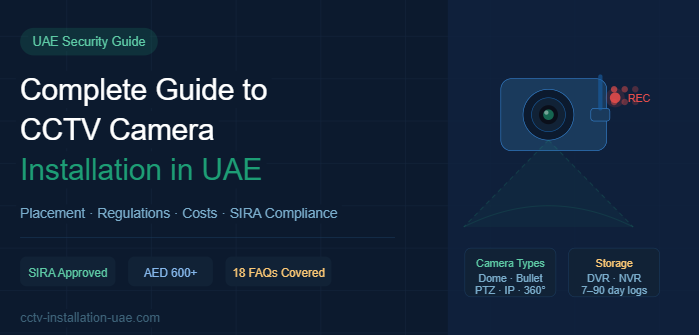
Wireless and WiFi-ready systems made easy install possible for renters and temporary setups — yet the professional process still demands discipline. We survey entrances, map cable paths, confirm power supply positions, then mount brackets before any camera gets connected to the NVR configuration stage.
Proper wiring, cable pulling, trunk drilling, and precise camera focusing follow sequentially. IP-based systems need network verification at each node before recording begins. Skipping firmware validation here is where most basic residential systems fail within their first year — something I’ve personally corrected dozens of times across villas and offices.
Where to Position CCTV Cameras
Gates, entrances, parking areas, and boundary walls represent non-negotiable coverage zones — these are statistically where incidents begin. Robust placement at stores and offices should account for extreme lighting shifts between morning and dusk, especially across expansive outdoor lots.
Night vision quality — whether infrared or full-color — determines how clear and high-contrast images appear in complete darkness. AHD technology still delivers high-definition, detailed footage at an accessible price point compared to feature-rich variants, making it relevant for outdoor perimeters where wide-area coverage matters most.
CCTV Laws and Regulations in UAE / Dubai
Recording audio without consent is strictly prohibited under UAE regulations — a detail many property owners overlook until compliance becomes a legal issue. Beyond audio, privacy laws govern exactly where cameras may face: filming neighbors’ windows or common areas without building management consent invites serious consequences.
Commercial properties face stricter mandatory SIRA guidelines, while residential installations benefit from following them advisably. Local police frameworks and Emirates-wide statutes both apply simultaneously — meaning a CCTV system installed without checking jurisdictional overlap can face dismantling regardless of equipment quality or brand choice.
What Is SIRA Approval and Why It Matters
Only SIRA-approved companies are allowed to install and maintain CCTV systems on commercial properties across the UAE — this isn’t advisory, it’s enforced. Checking an active SIRA license number against the official SIRA website before signing any contract protects both the client and the installation timeline.
Non-compliance exposes businesses to fines, legal action, and outright rejection of their licensing applications. From personal experience reviewing AMC agreements, those who skip SIRA certification checks often spend more correcting violations than the original installation cost — particularly in high-end corporate and mall environments where inspections are routine.
CCTV Installation Cost in the UAE
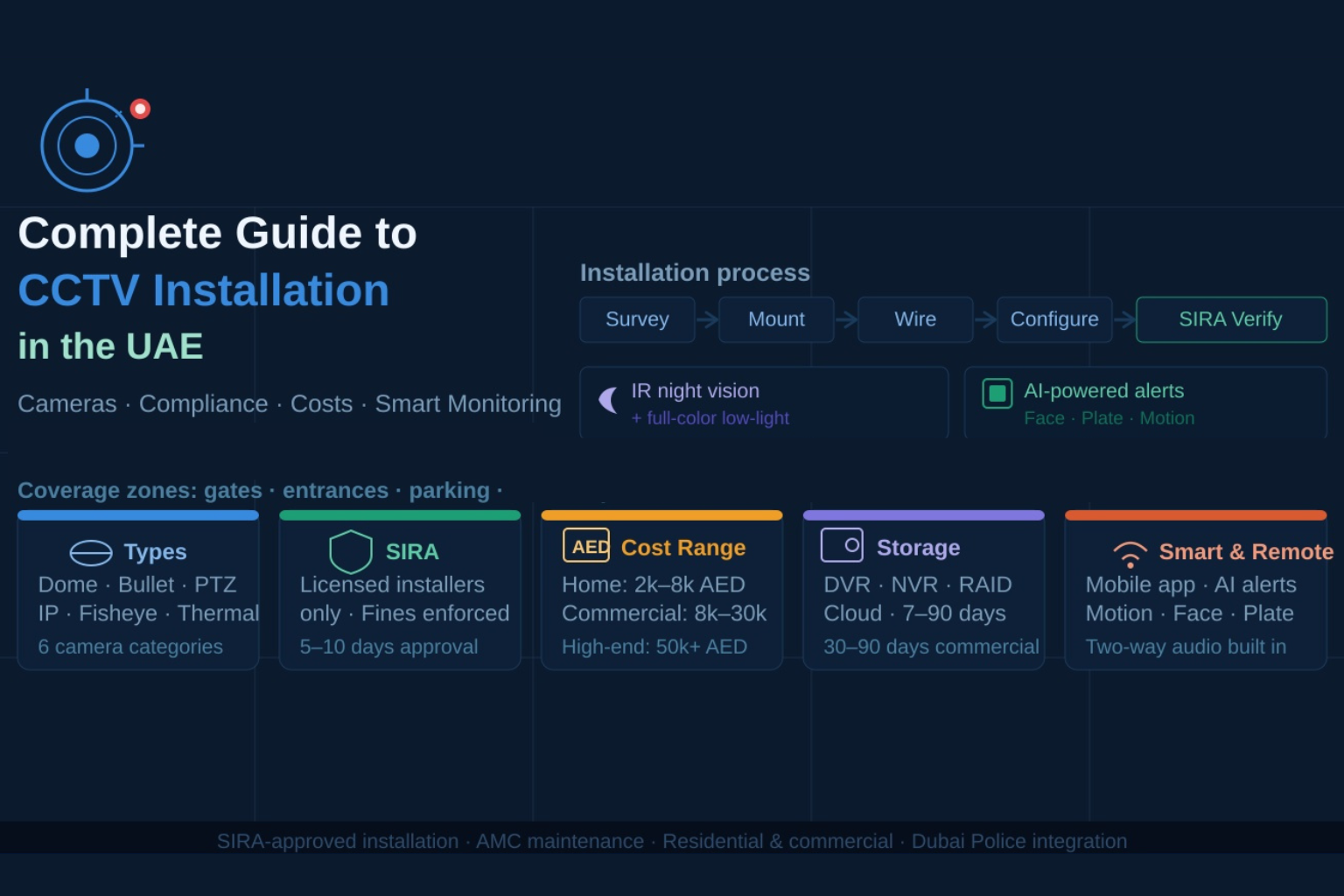
Camera type, resolution, property size, and wiring complexity define your total cost. Dome, bullet, PTZ, and IP cameras range AED 55–AED 2000. Basic residential systems with 2-4 cameras start at AED 2000, while commercial installations reach AED 30000. Hidden costs like cable pulling, trunk drilling, NVR configuration, and labor consistently surprise unprepared buyers.
High-end corporate, mall, and industrial systems exceed AED 50000; entry-level packages begin at AED 600–AED 799.
Wired vs. Wireless CCTV Cameras
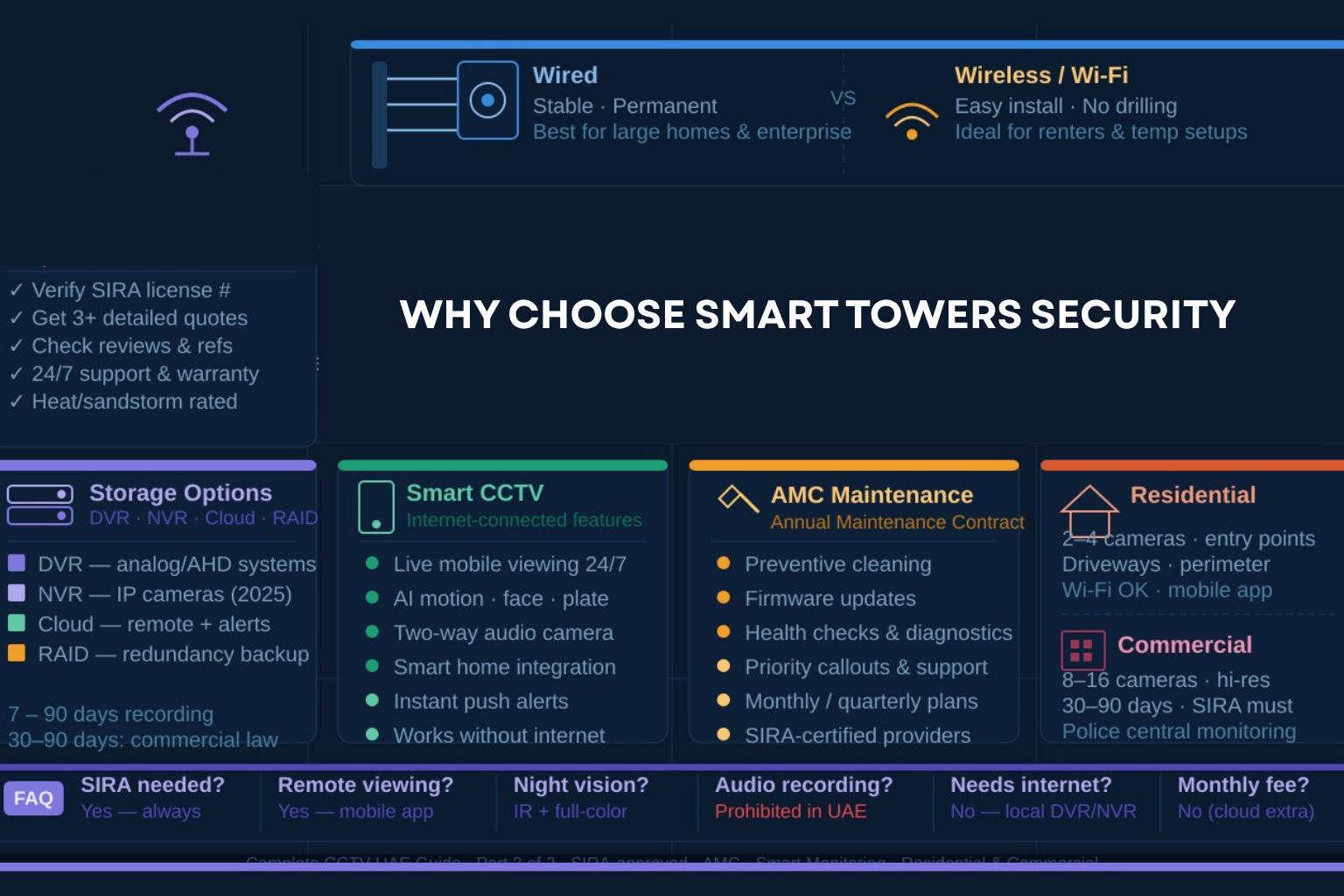
Wired cameras deliver stable, reliable, permanent installation — ideal for larger homes and high-security commercial environments where power and cabling integrity matter most. Wireless cameras are easier to install, requiring no complex wiring or drilling, making them perfect for renters, temporary setups, and battery or solar-powered configurations.
Wi-Fi-connected systems enable real-time monitoring via phone, tablet, or computer with instant alerts whenever motion is detected.
Storage Options for CCTV Systems
A DVR (Digital Video Recorder) manages analog and AHD camera systems; an NVR (Network Video Recorder) handles IP camera systems — the dominant choice in UAE 2025. Storage sized for 7-90 days depends on resolution and motion activity. RAID configurations ensure redundancy, while cloud storage keeps footage securely online with remote access and alerts.
Warehouses and commercial shops across the UAE require 30-90 days of recording for business insurance compliance.
Benefits of Internet-Connected / Smart CCTV Systems
Internet-connected CCTV cameras offer remote access to live footage and recordings via mobile phone, tablet, or computer — anytime, anywhere. AI-powered motion detection, facial recognition, and license plate recognition deliver intelligent alerts instantly. Two-way audio lets you communicate with visitors or intruders directly through the camera, transforming passive surveillance into active security.
Cloud storage and smart home integration further strengthen home automation and improved security across high-end UAE deployments.
How to Choose the Right CCTV Installation Company in UAE
Always verify an active SIRA license number on the official SIRA website before committing. Collect multiple quotes with detailed proposals from SIRA-approved providers and compare prices, scope of services, equipment quality, and warranty terms. Check independent reviews on social media and industry forums, and request references from recent clients.
Prioritize companies offering customized solutions, post-installation support, training, 24/7 surveillance scalability, and weather resistance for extreme heat and sandstorms.
CCTV Maintenance & AMC (Annual Maintenance Contract)
A CCTV system without regular maintenance simply won’t function properly long-term. A SIRA-approved CCTV provider delivers preventive cleaning, firmware updates, health checks, and thorough diagnostics — available through monthly or quarterly maintenance packages that include RAID options, secure backup, and ongoing optimization to meet all SIRA technical requirements.
AMC clients receive priority callouts, priority support, and faster response times under Annual Maintenance Contracts with SIRA-approved installers.
CCTV for Residential vs. Commercial Properties
Residential CCTV uses discreet camera placement at entry points, driveways, and perimeters — 2-4 cameras cover small apartments and villas effectively. Wireless/WIFI cameras suit temporary setups well. Commercial CCTV demands higher-resolution cameras, 30-90 days recording, employee monitoring, theft prevention, and mandatory SIRA approval covering entrances, exits, cash counters, parking, and Dubai Police central monitoring system integration.
Indoor cameras must respect household members’ privacy, while remote monitoring via mobile apps keeps owners connected anytime.
Frequently Asked Questions (FAQs)
Q1: Do I need a police-approved / SIRA-approved CCTV system in the UAE?
Yes — every CCTV system installed across the UAE Emirates must align with SIRA guidelines. Both commercial and residential properties fall under local police oversight, and only SIRA-approved companies are allowed to install and maintain CCTV systems on commercial properties legally.
Q2: Is SIRA approval mandatory for homes?
SIRA approval is non-negotiable for commercial and public buildings. For residential communities, compliance is highly advisable — many communities now mandate it. From experience, skipping proper residential installations review creates complications during property renewals and community audits.
Q3: How long does SIRA approval take?
Straightforward cases clear within 5-10 working days once documentation is submitted and an inspection schedule is confirmed. Expect 1-3 weeks for complex installations involving multi-floor layouts or high-channel configurations — always start this process before installation day.
Q4: Can I install CCTV without SIRA approval?
For businesses, SIRA compliance is a strict legal requirement — not a suggestion. Non-compliance triggers heavy fines, legal action, rejection of licensing applications, and potential dismantling of the entire system at the owner’s expense.
Q5: What is the difference between wired and wireless CCTV cameras?
Wired cameras provide stable, permanent installation best suited for larger homes and enterprises. Wireless cameras are far easier to install — purely Wi-Fi dependent — making them ideal for renters and temporary setups, especially battery or solar-powered models requiring zero cabling.
Q6: Can I view my CCTV cameras remotely on my phone?
Absolutely — modern CCTV systems connect directly through mobile apps, giving real-time remote access to live footage anywhere. Motion alerts are pushed instantly, and two-way audio on supported cameras lets you speak directly with whoever is on the other side.
Q7: Do CCTV cameras work at night?
Modern CCTV cameras use built-in infrared night vision as standard. High-end models now deliver full-color night vision — not just grayscale — performing reliably even in extreme low-light conditions common across UAE outdoor perimeters and parking areas.
Q8: How many cameras do I need?
It depends on size, layout, and property type. Prioritize vulnerable, high-traffic zones first. A small apartment or villa typically finds 2-4 cameras sufficient, while larger properties and commercial buildings genuinely require 8-16 cameras for complete, gap-free coverage.
Q9: How much does CCTV installation cost in the UAE?
Pricing depends on camera type, resolution, brand, property size, and wiring difficulty. Residential systems range AED 2000–AED 8000; commercial installations run AED 8000–AED 30000. High-end setups exceed AED 50000, while entry-level packages begin around AED 600 for basic coverage.
Q10: Is there a monthly subscription fee for CCTV services?
Standard CCTV installation services carry no recurring monthly subscription cost. Most reputable providers include a 1-year free warranty post-installation. Cloud storage features, however, typically attract a separate subscription fee — always clarify this before signing with any provider.
Q11: How long is the recording history available?
Systems can record and store footage from as few as 7 days up to 90 days, depending on storage setup and project requirements. Warehouses, commercial shops, and regulated businesses across the UAE commonly mandate 30-90 days of continuous recording history.
Q12: Can CCTV be installed in apartments?
Installation in Dubai apartments is possible but must respect privacy laws and building management policies. Cameras covering common areas require explicit management consent — pointing cameras toward neighboring units without approval breaches both legal and ethical boundaries.
Q13: Does CCTV installation reduce insurance costs?
Many insurers offer meaningful discounts when proof of an active CCTV camera installation is provided. It demonstrates proactive risk management — reducing liability exposure and often recovering a portion of the initial system investment over time.
Q14: Is CCTV installation expensive for small shops?
Not at all. Small shops can access genuinely economical packages covering 2-4 cameras for AED 2000–AED 8000, inclusive of all equipment and installation. Final costs scale only with system complexity — straightforward retail setups remain very affordable.
Q15: Can I upgrade my existing CCTV system?
Yes — a qualified professional installer will assess your current setup and recommend targeted upgrades, whether replacing outdated cameras, refreshing the DVR or NVR, or improving software integration without requiring a full system overhaul.
Q16: What brands of CCTV cameras are recommended in the UAE?
Several leading brands dominate the UAE market for reliable performance, strong SIRA approval compatibility, and broad service networks. Choosing widely used systems ensures easier maintenance, faster parts availability, and better long-term technical support.
Q17: Does CCTV need internet to work?
No — CCTV systems record footage locally to DVR or NVR devices without any internet connection. You can still monitor and playback footage on-site freely. Internet simply unlocks remote viewing and real-time alerts as added layers.
Q18: Can cameras record audio?
Recording audio without explicit consent is strictly prohibited under UAE regulations. Even where technically possible, full compliance is mandatory — covert audio recording carries serious legal penalties regardless of intent or property type.