
Security Solutions for Retail Stores
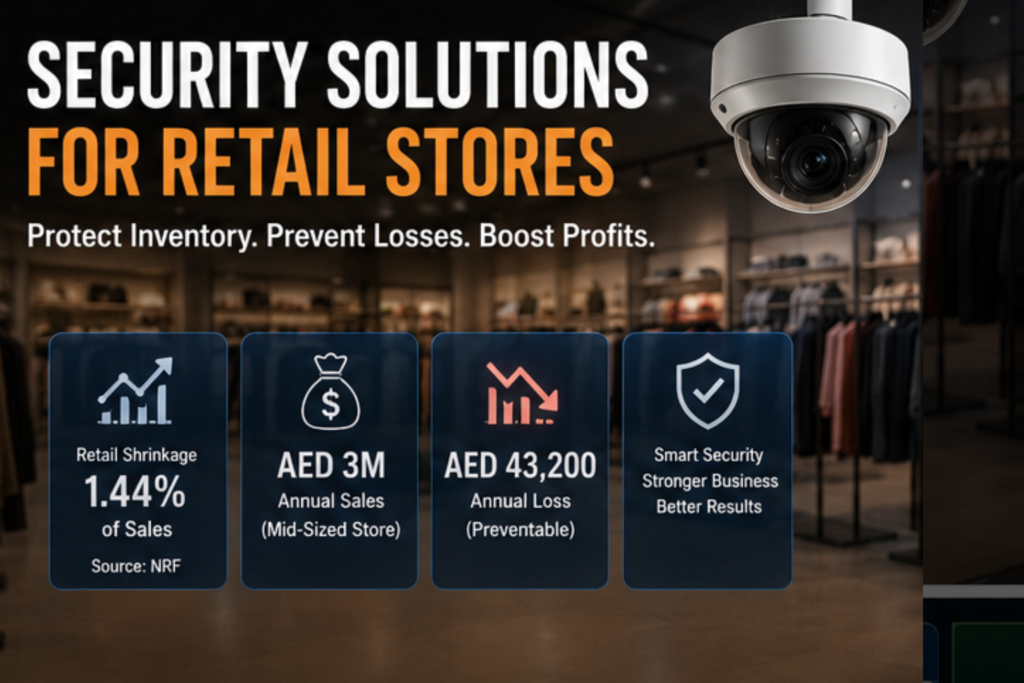
Most retailers invest in security systems after experiencing a significant inventory loss. That sequence is costly. Shrinkage, shoplifting, and internal theft don’t announce themselves — they compound silently across every shift, every transaction, and every blind spot in your store layout. The NRF retail loss research places average retail shrinkage at 1.44% of sales. For a mid-sized UAE store generating AED 3 million annually, that’s AED 43,200 in preventable losses. Electronic Article Surveillance, CCTV analytics, and access control each address a distinct shrinkage vector — none alone is sufficient.
The Layered Security Model Nobody Talks About
Practitioners rarely lead with EAS pedestals. The more instructive starting point is your threat profile — who is stealing, what they’re taking, and how. Organized retail crime groups operate differently than opportunistic shoplifters. Your security infrastructure must account for both, using different countermeasures at different detection points.
Anti-theft technology deployed without a mapped store layout and customer flow analysis routinely underperforms. AM systems placed incorrectly create detection gaps. IP cameras positioned at the wrong angle miss blind spots that experienced thieves exploit within days of store opening. The hardware is secondary to the strategic placement.
Electronic Article Surveillance: Frequency Matters More Than Brand
EAS systems operate on two primary frequencies: acousto-magnetic (AM) at 58 kHz and radio-frequency (RF) at 8.2 MHz. The difference is not academic. AM technology delivers superior detection rates in environments with metal fixtures, foil packaging, and dense product layouts — characteristics of most UAE retail formats.
RF labels are thinner, cheaper, and more compatible with source tagging programs where manufacturers apply security labels during production. For high-SKU environments like pharmacies or supermarkets, RF reduces in-store tagging labour significantly. For apparel and electronics, AM hard tags remain the professional standard.
Hard tags, soft labels, spider wraps, ink tags, and bottle stoppers each serve specific merchandise categories. Choosing the wrong tag type generates false alarms, staff fatigue, and customer complaints at the POS counter during deactivation. See compatible options at security solutions.
CCTV in 2026: Intelligence, Not Just Recording
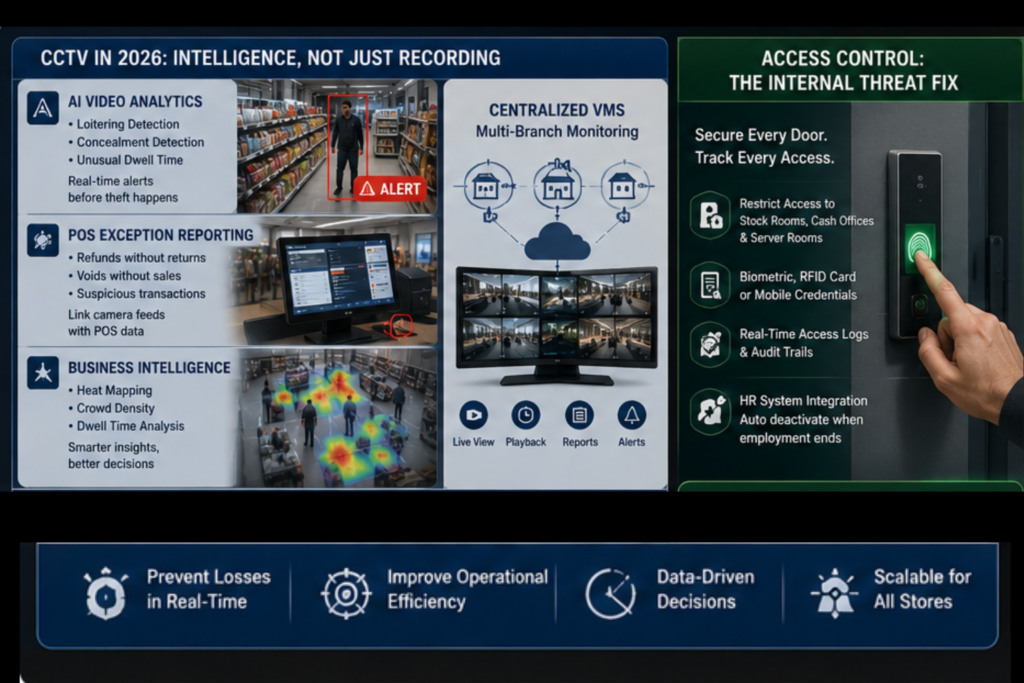
Legacy CCTV mindset treats cameras as evidence collection tools. Modern IP camera systems with AI video analytics operate as real-time intervention platforms. Behaviour detection algorithms flag loitering, concealment gestures, and unusual dwell time near high-value merchandise zones — alerting staff before a theft completes.
POS exception reporting links camera feeds directly to transaction data. When a refund or void occurs without a corresponding customer return, the system flags it automatically. This single integration alone recovers significant losses from employee theft — the shrinkage category retailers least like to discuss. Explore CCTV surveillance.
Heat mapping and crowd density monitoring add a business intelligence layer beyond pure security. Customer movement patterns, dwell zones, and peak footfall periods inform merchandising decisions as much as loss prevention planning. Multi-branch retailers benefit from centralized VMS aggregating feeds across all locations.
Access Control: The Internal Threat Fix
Interpol theft data consistently shows internal theft as a top-three shrinkage contributor. Access control systems restrict entry to stock rooms, cash offices, and server rooms via biometric readers, RFID cards, or mobile credentials — creating an audit trail for every access event.
The most overlooked feature is HR system integration. When a staff member’s employment ends, their access credentials should deactivate instantly — automatically, not manually. Most UAE retailers relying on physical keys or PIN codes never update credentials post-termination. That gap is a documented theft vector. Full access control integration closes it.
Alarm Systems and Remote Monitoring: The After-Hours Layer
Security Solutions for Retail Stores : alarm systems combining PIR motion detectors, glass break sensors, and door contacts protect against after-hours burglary — the highest-value theft category by incident. Dual-verification systems require two independent triggers before alerting a Central Monitoring Station (CMS), reducing false call-out rates while maintaining UAE police compliance.
Remote monitoring via a Security Operations Centre (SOC) extends professional surveillance coverage to hours when in-store staffing is impossible. Connected to your CCTV and alarm infrastructure, SOC operators respond in under 60 seconds to any anomaly — dispatching mobile patrols or coordinating emergency services. Learn more at retail security.
Content by itsolus.net · Sources: NRF · Interpol