
How Real-Time Intelligence Is Rewriting the Rules of Security
Modern surveillance doesn’t blink. It processes, predicts, and responds before human eyes can register a threat. At the core of this transformation sits big data — a term once reserved for tech boardrooms, now deeply embedded in the infrastructure of public safety, urban monitoring, and national security. The convergence of these fields has produced something both remarkable and sobering: systems that know more about a crowd than the crowd knows about itself.
What Big Data Actually Means in a Surveillance Context
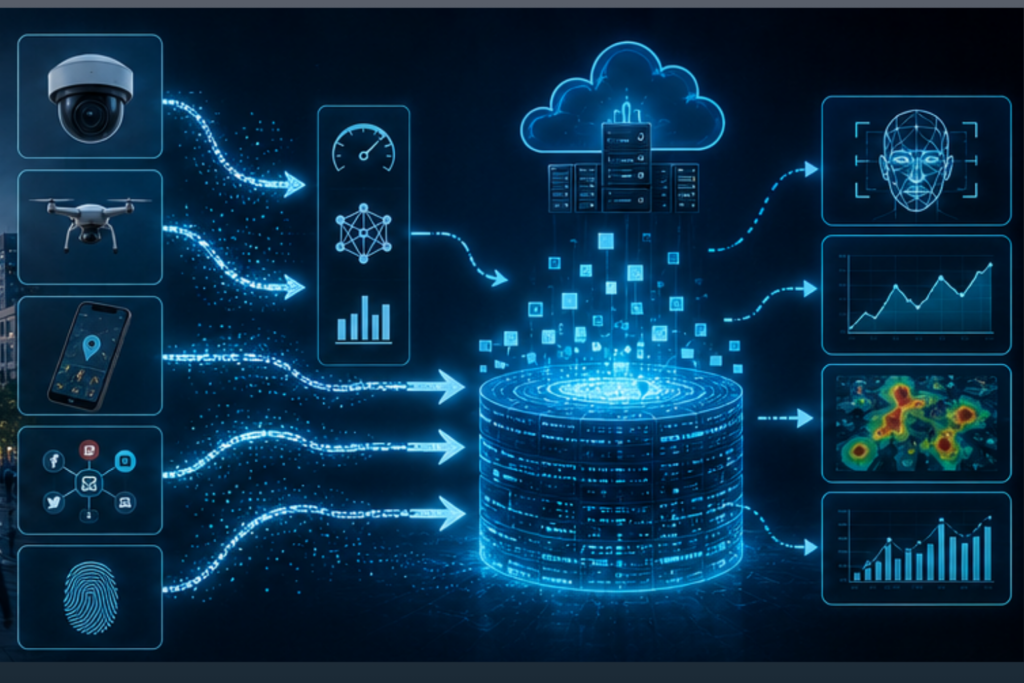
Big data refers to the high-velocity, high-volume, and high-variety streams of digital information generated continuously from IoT devices, CCTV networks, mobile sensors, social media platforms, and biometric scanners. In surveillance systems, this data is not stored passively — it is actively processed through machine learning algorithms, predictive analytics engines, and real-time data pipelines. The result is a situational awareness capability that traditional systems never achieved.
Data collection, pattern recognition, behavioral analysis, and anomaly detection form the operational backbone. Every facial recognition query, every license plate scan, every geolocation ping contributes to a continuously updated intelligence layer. Structured data from databases merges with unstructured data from video feeds, creating a multi-dimensional threat profile that evolves in real time.
AI and Machine Learning: The Engine Behind Intelligent Monitoring
Without artificial intelligence, big data in surveillance is just noise. AI-powered surveillance platforms apply deep learning models, neural networks, and computer vision to extract meaning from raw feeds. A single smart camera equipped with video analytics can identify suspicious behavior, track object movement, flag unauthorized access, and cross-reference identities — all within milliseconds.
Predictive policing tools leverage historical crime data, demographic patterns, and environmental variables to generate risk scores for specific zones. Law enforcement agencies across the globe deploy these intelligent surveillance systems alongside natural language processing tools that scan digital communications for threat indicators. The fusion of data mining, geospatial analysis, and behavioral profiling has fundamentally changed what it means to monitor a city.
Explore AI-powered security solutions →
Smart Cities and the Infrastructure of Total Awareness
Smart city surveillance is where big data achieves its most ambitious expression. Urban data infrastructure integrates traffic monitoring systems, environmental sensors, crowd density analytics, and emergency response networks into a unified command and control platform. Cities like Dubai have accelerated investment in integrated security ecosystems that blend public safety technology with urban planning intelligence.
Edge computing plays a pivotal role here. Rather than transmitting every byte to centralized data centers, edge-enabled surveillance cameras process data locally, reducing latency and increasing response times. 5G connectivity further amplifies this capability, enabling real-time streaming of high-resolution video feeds across thousands of simultaneous nodes without network congestion.
Data lakes, cloud storage infrastructure, and distributed computing frameworks like Hadoop and Spark power the backend. The entire ecosystem depends on data integration, scalability, and cybersecurity protocols that protect sensitive surveillance data from unauthorized access and data breaches.
Privacy, Ethics, and the Surveillance Paradox
The expansion of big data surveillance invites a critical question: at what cost does public safety come? Privacy concerns, civil liberties, and data governance frameworks are increasingly strained by the scale of mass surveillance systems. Facial recognition technology, in particular, has drawn scrutiny for algorithmic bias, false positives, and its disproportionate impact on specific demographic groups.
Regulatory compliance frameworks — including GDPR, regional data protection laws, and surveillance ethics guidelines — attempt to balance security imperatives with individual rights. Transparency, data minimization, and consent mechanisms are central to any ethical surveillance data management policy. The challenge for security operators and technology providers is deploying powerful monitoring capabilities without eroding the trust of the communities they serve.
Accountability structures, audit trails, and independent oversight bodies are increasingly being integrated into surveillance governance models. This isn’t just a legal obligation — it’s a functional necessity for sustainable public safety infrastructure.
Learn how ITSolus approaches ethical tech deployment →

Cybersecurity Threats to Surveillance Networks
Ironically, the systems designed to protect us represent significant cybersecurity vulnerabilities. Surveillance networks built on interconnected IP cameras, wireless sensors, and cloud-based platforms are prime targets for cyberattacks, data interception, and ransomware. A compromised CCTV infrastructure doesn’t just go dark — it can be weaponized, feeding false data into AI systems and disrupting emergency response coordination.
Encryption standards, network segmentation, intrusion detection systems, and zero-trust architecture are essential safeguards. Endpoint security across every connected device in a surveillance ecosystem must be maintained with continuous patch management and threat intelligence updates. The intersection of big data security and physical surveillance demands a unified cybersecurity strategy rather than siloed responses.
The Future: Predictive, Autonomous, and Everywhere
The trajectory of big data in surveillance points toward autonomous monitoring systems capable of operating with minimal human intervention. Drone surveillance, satellite imaging analytics, acoustic sensors, and thermal cameras are being integrated into platforms that deliver 360-degree situational awareness. Predictive threat modeling, powered by generative AI and large language models, will soon allow systems to simulate potential security incidents before they materialize.
Biometric surveillance — encompassing gait recognition, voice identification, and iris scanning — is expanding beyond borders into commercial spaces, transport hubs, and retail environments. The data ecosystem supporting these tools will grow exponentially, demanding smarter data management, more sophisticated privacy engineering, and stronger international governance frameworks.
The organizations that will lead in intelligent surveillance are those that master not just the technology stack, but the ethical architecture around it.
Discover how ITSolus builds future-ready security infrastructure →
FAQs: Big Data in Surveillance
What is big data surveillance? Big data surveillance refers to the use of large-scale data collection, processing, and analysis technologies — including AI, machine learning, and IoT networks — to monitor individuals, spaces, and behaviors for security or intelligence purposes.
How is AI used in surveillance systems? Artificial intelligence enables real-time video analytics, facial recognition, behavioral pattern detection, and predictive threat assessment within modern surveillance platforms, dramatically increasing both speed and accuracy.
What are the privacy risks of big data in surveillance? Key risks include algorithmic bias, unauthorized data retention, function creep, and the erosion of civil liberties without adequate regulatory oversight or transparency mechanisms.
Is big data surveillance legal? Legality depends on jurisdiction. GDPR in Europe, regional data protection laws, and sector-specific regulations govern how surveillance data can be collected, stored, and used. Compliance requires ongoing legal review.
How can organizations protect surveillance data? Through encryption, access control policies, network segmentation, regular audits, and alignment with recognized cybersecurity frameworks such as ISO 27001 or NIST.