Introduction
Most businesses in Sharjah discover CCTV approval requirements only after facing penalties. Sharjah Police enforces strict security standards across every district, making compliance non-negotiable. Early understanding protects your trade license and operational continuity from day one. Working with a Sharjah Police-recognized authorized service provider transforms a complex regulatory process into a structured journey. Every facility requiring camera installation must align with UAE law — the right certified companies make that seamless.
Sharjah Police & The CCTV Regulatory Authority
Sharjah Police ESCD oversees every CCTV installation against defined safety standards, requiring valid CCTV certification before any security system installation begins. Engineers and technicians must carry verified ID credentials on-site. Only approved CCTV equipment — including CCTV cameras and other security systems — clears inspection. Vital facilities and security systems users without certified infrastructure face immediate action. The security monitoring system framework references ONVIF (Open Network Video Interface Forum) standards, mandates WDR (Wide Dynamic Range) in high-contrast zones, requires IR (Infrared Radiation) for low-light areas, enforces IP Rating (Ingress Protection Rating) on outdoor units, and demands RAID (Redundant Array of Inexpensive Disks) for storage redundancy — protecting privacy of individuals across every private places and facility access point.
Who Needs CCTV Approval in Sharjah?
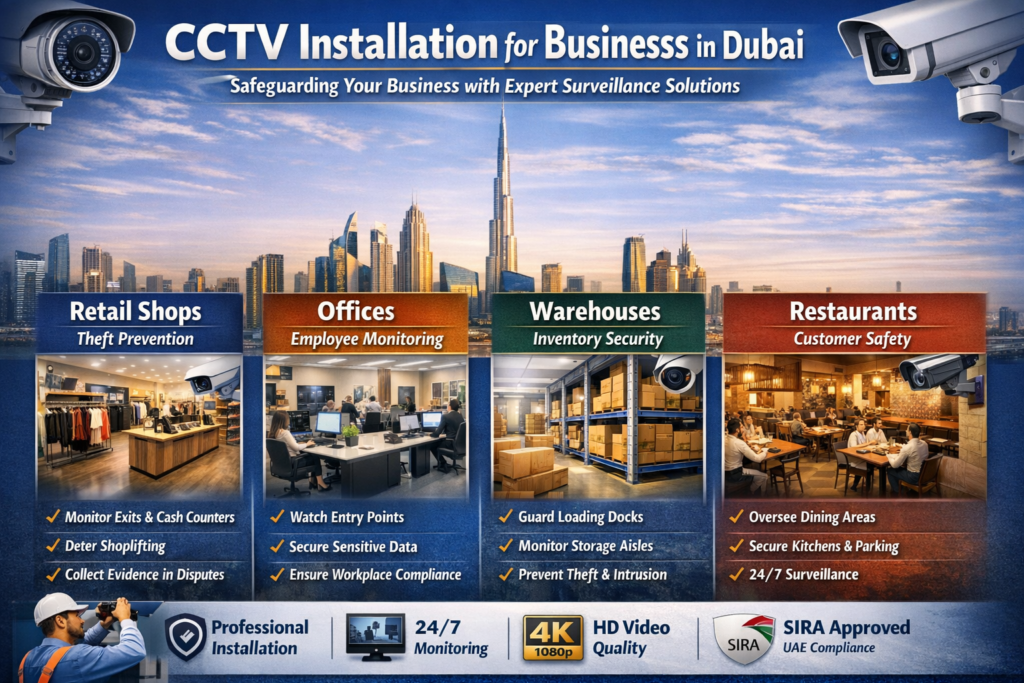
Security camera installation is mandatory across industrial areas, hotels, banks, restaurants, cafeterias, and commercial establishments operating 24 hours. Businesses, offices, and warehouses fall under UAE law mandating Sharjah Police Approved CCTV Cameras for crime prevention and public safety. Residential owners must respect neighbours privacy, restricting cameras to entrances, parking lots, and elevators only.
CCTV Approval Process — Step by Step
Government authorities require a formal approval application — site layout, camera placements, system specs, and UAE privacy laws alignment — before any permit is granted. After installation, the system is tested against Sharjah Police guidelines to confirm it is 100% compliant. A representative checks performance before the certificate is issued. Minor form errors can delay clearance by six months — a lesson many first-time applicants learn the hard way.
Sharjah Police CCTV Technical Specifications & Regulations
The Sharjah Police framework sets precise observation criteria — determining whether a security monitoring system can identify an unknown person or simply record blurred shapes. Every whole place requires overlapping coverage, leaving zero blind spots that could compromise evidentiary value during any incident review.
1. Surveillance Camera Technical Specifications and Conditions of Use
Outdoor deployments skipping WDR fail in split-light environments. Fixed cameras with Auto Iris handle changing light far better. Main entrances require outdoor cameras at 4MP minimum; interiors accept 2MP at 1080p. IR cameras extend night visibility. Wireless cameras remain prohibited — prior approval from the concerned authority is mandatory before roof-mounting anything. All camera locations must appear on a formal submitted map, with CCTV Cameras in Operation signage displayed at every entry point.
2. Technical Specifications of Connections and Operational Capacity
Cabling runs through dedicated conduits, fully separated from standard building wiring. Both essential power supply and backup power supply lines are secured independently. High-quality cables are non-negotiable — substandard wiring degrades signal integrity, particularly in Sharjah’s heat. All connections must remain visible during inspections.
3. Technical Specifications of Recording Systems
H.264 compression enables continuous recording at 25 images per second without exhausting storage. The video storage period cannot fall below 60 days minimum. Alarm-based recording captures 10 seconds pre- and post-motion. Each recorder is labeled and housed in a dedicated control room connected via dedicated intranet. Recorded videos must support search by camera number, time, and date. The system must auto-restart after power restoration, with backup power supply sustaining at least 30 minutes of operation.
4. Technical Specifications of Monitors
A recorder handling 16 cameras requires a minimum 21-inch HD monitor — anything smaller compromises detail detection across simultaneous feeds. All screens must be certified HD monitors capable of sustaining clarity across extended operational hours. Substandard displays have directly caused missed incidents at facilities I’ve reviewed across the emirate.
5. Other Requirements
Digital recorders and equipment must be sourced from registered suppliers holding concerned authority approvals. Every approved company engagement covers installation and ongoing management access for authorized user accounts — essential when viewing and re-viewing of recorded materials is needed. The surveillance system maintenance contract governs how recorded images and videos are accessed via intranet or computer, with every copying process fully logged.
Privacy Laws & Prohibited Practices
UAE privacy laws bar recording in restrooms, bathrooms, and changing rooms — spaces where individuals hold a reasonable expectation of privacy. Pointing cameras at private areas or neighbouring homes is equally prohibited. Unauthorized sharing or misuse of recorded footage, including recording audio without consent, is strictly prohibited.
Consequences of Non-Compliance / Penalties
A CCTV system that fails to record any incident triggers refusal of trade license renewal by Sharjah authority. Non-certified companies conducting unauthorized installation violate health regulations and face hefty fines, legal action, and costly penalties. Without a compliant system, business continuity breaks down — employees, customers, and operations all suffer the fallout.
Annual Maintenance Contract (AMC) in Sharjah
Skipping an AMC causes cascading failures — digital recorders degrade, recorded images and videos become inaccessible, and the copying process stalls. Certified companies handle camera installation upkeep, service contracts, and viewing and re-viewing of recorded materials via intranet or computer, keeping systems running smoothly and staying cost-effective for every user, suppliers, and management team.
Benefits of Installing CCTV Cameras in Sharjah
Surveillance cameras deter theft, vandalism, and intruders while enabling remote monitoring of properties via smartphones, tablets, and computers in real time. Smart integrations with alarm systems and access control create a holistic security solution. Motion detection, alerts, and notifications flag unusual activity, and video footage supports evidence collection for law enforcement during any security breach or criminal incident. Mobile monitoring via smartphone apps, 24/7 enhanced security, peace of mind for loved ones, legal protection of valuable assets, and cost efficiency against thefts and damages — with smart devices resolving disputes and legal issues — make CCTV truly indispensable.
Why Choose a Sharjah Police Approved CCTV Company
A Sharjah Police-approved CCTV company delivers highest safety values, compliance, and end-to-end solutions — from consultation and site surveys through designing, installing, and active maintenance. Certified professionals keep premises secure, offering troubleshooting, support, and technical assistance whenever needed. Covering homes, offices, and factories, a qualified Sharjah Police-approved CCTV provider sources globally recognized CCTV brands for durability and exceptional performance. Customized solutions address security requirements — including smart home and business automation — with seamless control, enhanced safety, peace of mind, protection, and 24/7 technical assistance built in.
FAQs
Q1. Sharjah Police approves only surveillance systems meeting strict security standards and regulations under UAE law — mandatory for businesses, offices, warehouses, and commercial establishments to ensure genuine safety and crime prevention through verified compliance.
Q2. Commercial establishments without approved CCTV cameras risk trade license suspension and fines. Monitoring gaps breach public safety obligations — legal compliance failures attract penalties that escalate with every inspection cycle, and 24/7 protection remains non-negotiable.
Q3. Your authorized service provider must present proof that every component of your installation was tested against Sharjah Police guidelines. Only 100% compliant configurations pass regulatory scrutiny — systems without documented verification consistently fail on-site audits.
Q4. Hospitals, malls, restaurants, offices, warehouses, and industrial areas all carry active mandates. These commercial establishments and businesses must sustain 24 hours uninterrupted coverage — zero operational gaps permitted across any Sharjah-regulated premises.
Q5. Businesses need formal approval from government authorities before installation. Private homes carry lighter requirements, but neighbours privacy and public areas remain protected. Installing CCTV cameras without clearance draws regulatory scrutiny regardless of intent.
Q6. Without a compliant system, your business faces fines, legal action, and trade license renewal refusal from Sharjah authority. Employees and customers lose protection, while costly penalties and health regulations violations accumulate rapidly.
Q7. Once approved companies complete your CCTV installation, a representative visits to check system integrity across installation systems. Only authorized companies with verified sales and installation credentials can certify your setup — the certificate issued then confirms full compliance.
Q8. Sharjah Police regulations classify wireless cameras as prohibited for regulated premises. Signal vulnerabilities, interception risks, and inconsistent uptime make wired infrastructure the only architecture meeting current mandatory thresholds.
Q9. Under Sharjah Police regulations, the video storage period carries a firm 60 days minimum. Sites falling short during inspections receive immediate compliance flags — camera count offers no buffer if storage continuity cannot be verified.
Q10. Sharjah Police actively inspects premises — reviewing camera installation records, maintenance logs, service contracts, and license renewals simultaneously. Clearance is withheld whenever documentation gaps appear against operational evidence.
Q11. Recording audio without consent is strictly prohibited under UAE privacy laws, independent of any video approval. A valid CCTV permit grants no audio rights — this distinction carries real enforcement consequences.
Q12. The concerned authority mandates a surveillance system maintenance contract with approved companies to retain police clearance and support license renewals. Certified companies administering Maintenance contracts cover your full CCTV Installation lifecycle without gaps.
Q13. Our expert team delivers CCTV installation services across the entire UAE — Dubai, Abu Dhabi, Sharjah, and beyond — for homes, businesses, and industrial facilities, producing comprehensive security solutions matched precisely to your security needs.