
Edge Computing in Security Cameras
Modern IP cameras now capture 4K resolution footage at 30 fps — yet that power creates a hidden crisis. A single camera generates up to 20 Mbps of continuous data. Scale that across 100 cameras, and your network infrastructure buckles under 1.5 Gbps of sustained traffic. This is the silent breaking point most surveillance deployments never talk about.
The traditional model — shipping every raw video stream to a centralized server or cloud storage — was never built for this volume. Edge computing redraws the rules entirely. By embedding onboard processing directly inside the camera, intelligence shifts to the point of capture. What gets transmitted is no longer footage, but decisions. For organizations running smart surveillance systems, this isn’t a minor upgrade — it’s a rethink of the entire architecture.
What Is Edge Computing in Security Cameras
At its core, edge computing means processing video data closer to its source — the camera itself or a nearby edge device — rather than routing everything to remote servers. Think of it as giving each camera a mini-brain: a System on Chip (SoC) running deep learning algorithms and object detection models locally.
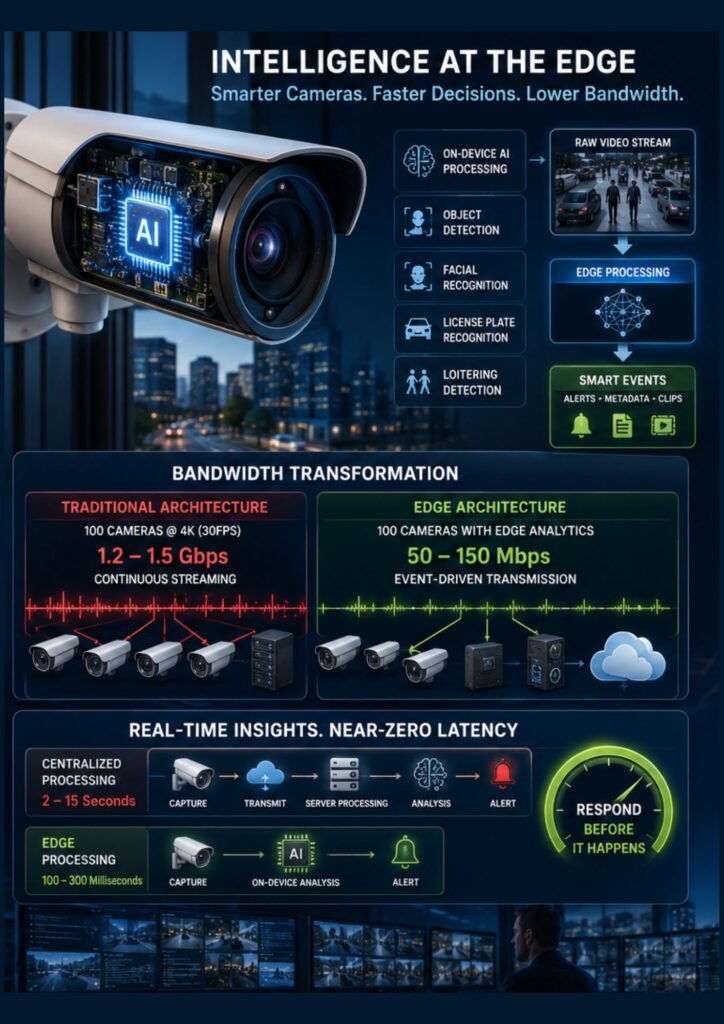
These aren’t lightweight filters. Today’s edge-capable cameras run the same convolutional neural networks (CNNs) previously reserved for server-class GPUs. They perform behavioral analysis, facial recognition, loitering detection, and license plate reading — all within the device, with minimal power consumption. Only alert notifications, event metadata, and relevant video clips leave the camera. Continuous data transfer of empty corridors never happens.
How Edge Computing Fixes the Bandwidth Bottleneck
A 100-camera CCTV deployment streaming at full quality demands 1.2–1.5 Gbps of sustained bandwidth. For sites using WAN links, satellite connectivity, or shared network infrastructure, this is simply unworkable. Edge computing collapses that figure dramatically.
When cameras perform local analytics and on-device recording, only event-triggered clips, alert notifications, and proxy streams travel the network. That same 100-camera site may require just 50–150 Mbps — a reduction that makes advanced video analytics viable on existing infrastructure without costly upgrades. Bandwidth efficiency isn’t a bonus; it’s what makes scalable surveillance possible at remote sites and distributed locations.
Dynamic prioritization adds another layer: during network congestion, cameras auto-adjust, reducing stream quality for routine footage while ensuring event-triggered video transmits at full resolution. This intelligent bandwidth management maintains system function even under suboptimal conditions. Learn how IT solus deploys edge-optimized surveillance for enterprise environments.
Real-Time Insights and Near-Zero Latency
In centralized architectures, a threat detected on camera must travel to a server, be decoded, processed through analytics algorithms, and trigger a response — a round trip adding 2–15 seconds of delay. That window can mean the difference between intervention and incident.
Edge computing eliminates this latency lag entirely. When a camera’s onboard processor detects a person crossing a virtual tripwire, the alert fires within 100–300 milliseconds — essentially real-time. Automated responses like barrier activation, PTZ camera redirection, or audio warnings can engage before a threat escalates, not after.
This speed is critical in fall detection for healthcare facilities, hazardous zone monitoring on industrial sites, and perimeter intrusion detection at critical infrastructure. Seconds genuinely matter in these environments, and sub-second response isn’t a marketing claim — it’s a measurable operational advantage.
Enhanced Data Privacy and Scalability
Processing sensitive footage locally means it never traverses external networks unnecessarily. This dramatically reduces exposure to data breaches during data transfer — a key compliance requirement under regulations like GDPR and CCPA. Organizations in banking, healthcare, and government sectors find this architecture uniquely aligned with their data security obligations.
Scalability follows naturally from distributed processing. Rather than bottlenecking a single centralized server, the workload spreads across multiple edge devices. Adding cameras doesn’t overwhelm backend infrastructure — it simply adds more autonomous processing capacity to the network. Modular upgrades and containerized applications make rolling out new machine learning models across edge nodes practical at scale.
Applications Across Smart Cities, Retail, and Healthcare
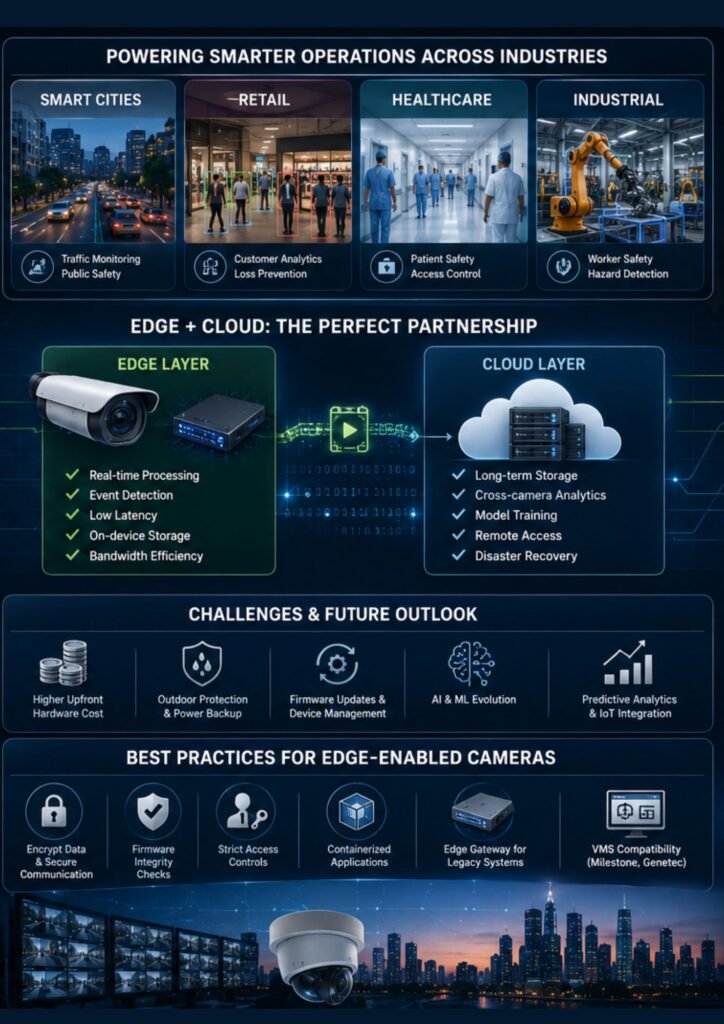
Smart cities deploy edge-enabled cameras to monitor traffic patterns, detect accidents, and improve public safety — all without routing every frame to a central hub. Retail environments use edge analytics to analyze customer behavior, optimize store layouts, and prevent shoplifting through real-time object detection.
On industrial sites, edge cameras ensure worker safety by flagging when personnel enter restricted zones without triggering false alarms from background motion. In healthcare, the same technology manages hospital security, monitors patient safety, and enforces access control in restricted areas. The shift from reactive to proactive surveillance is most visible in these real-world deployments.
Edge vs. Cloud: A Complementary Partnership
A common misconception frames edge computing and cloud computing as competing architectures. In practice, the most resilient systems exploit both. Edge devices handle real-time processing — detecting objects, triggering alerts, filtering data — while cloud infrastructure manages long-term storage, cross-site analysis, machine learning model training, and remote access for authorized users.
The optimal hybrid architecture works in sequence: edge cameras perform initial analysis, relevant events trigger transmission of clips and metadata, and the cloud handles retention, pattern analysis, and disaster recovery. Neither layer is redundant. IT solus designs hybrid edge-cloud surveillance platforms built for exactly this kind of operational balance. For more on cloud-edge integration.
Challenges and Future Outlook
Upfront costs for AI-enabled edge cameras remain higher than standard hardware. Outdoor deployments require weatherproof enclosures and battery backups. Firmware updates, device health monitoring, and automated diagnostics add operational overhead — though organizations using best practices report up to 35% lower maintenance costs during large-scale implementations.
The trajectory is clear: as AI and machine learning evolve, predictive analytics, behavior forecasting, and IoT ecosystem integration are closing in fast. Proactive surveillance — systems that anticipate incidents rather than merely recording them — is no longer theoretical. The paradigm shift from passive CCTV to intelligent, distributed computing networks is already underway.
Best Practices for Deploying Edge-Enabled Cameras
Start with encrypted communication and firmware integrity checks across all devices. Enforce strict access controls to prevent unauthorized configuration changes. Use containerized applications to simplify deployment, scaling, and machine learning model updates across distributed edge nodes without service interruption.
For legacy systems, edge gateways or AI-enabled IP cameras can transform existing setups into hybrid cloud-edge configurations without full replacement. Compatibility with Video Management Systems (VMS) like Milestone or Genetec ensures seamless integration with current infrastructure. A capable implementation partner helps you build resilient, scalable edge-powered systems that grow without architectural debt.
Frequently Asked Questions
What is edge computing in security cameras? Edge computing in security cameras means the camera processes video data locally using an onboard processor, rather than sending raw footage to a centralized server. It enables real-time analytics, reduces latency, and lowers bandwidth demands.
How does edge computing improve data privacy? By processing sensitive footage on-device, edge computing minimizes exposure during data transfer. This supports compliance with GDPR, CCPA, and other data security regulations by keeping footage local rather than transmitting it to external infrastructure.
Is edge computing better than cloud-based surveillance? Neither is strictly superior. Edge computing excels at real-time processing and autonomous decision-making; cloud computing handles long-term storage, cross-camera analysis, and remote management. The most powerful systems combine both in a hybrid architecture.
What industries benefit most from edge computing in CCTV? Smart cities, retail, healthcare, and industrial sites see the greatest impact. Use cases range from traffic monitoring and shoplifting prevention to worker safety enforcement and patient safety monitoring in restricted access zones.
Can edge computing work with existing surveillance systems? Yes. Edge gateways and AI-enabled IP cameras can integrate with legacy setups, enabling hybrid cloud-edge configurations without complete infrastructure replacement. VMS compatibility ensures continuity across existing deployments.