
Smart Eyes That Never Blink: Facial Recognition Technology in CCTV
How AI-powered biometric surveillance is reshaping security, privacy, and the future of public safety.
The moment a face appears in a camera’s frame, something extraordinary happens — algorithms map distances between eyes, trace jawline contours, and cross-reference a database in milliseconds. Facial recognition technology has quietly transitioned from a sci-fi concept to a cornerstone of modern CCTV surveillance systems. Whether it’s a shopping mall in Dubai or an international airport, biometric identification now operates at a scale and speed that no human security team could match alone.
From real-time identification of known suspects to touchless access control, this technology carries extraordinary promise — and equally extraordinary responsibility. Understanding how it works, where it’s applied, and what risks it carries is essential for any organization investing in intelligent security solutions.
How Facial Recognition Technology Works in CCTV
At its core, facial recognition within a CCTV network runs through a defined pipeline. The CCTV camera captures a live video frame; the system then isolates and detects a face using deep learning models and AI-powered analytics. Next comes facial feature mapping — measuring precise geometry: eye gap, nose shape, cheekbone prominence, and jawline structure.
This geometric data is converted into a digital faceprint — a biometric template. The template is fed into a matching algorithm that queries a watchlist database in under a second. A positive match triggers an automated alert. Modern systems also incorporate 3D facial mapping and infrared sensors for low-light surveillance environments, far outperforming older 2D recognition methods.
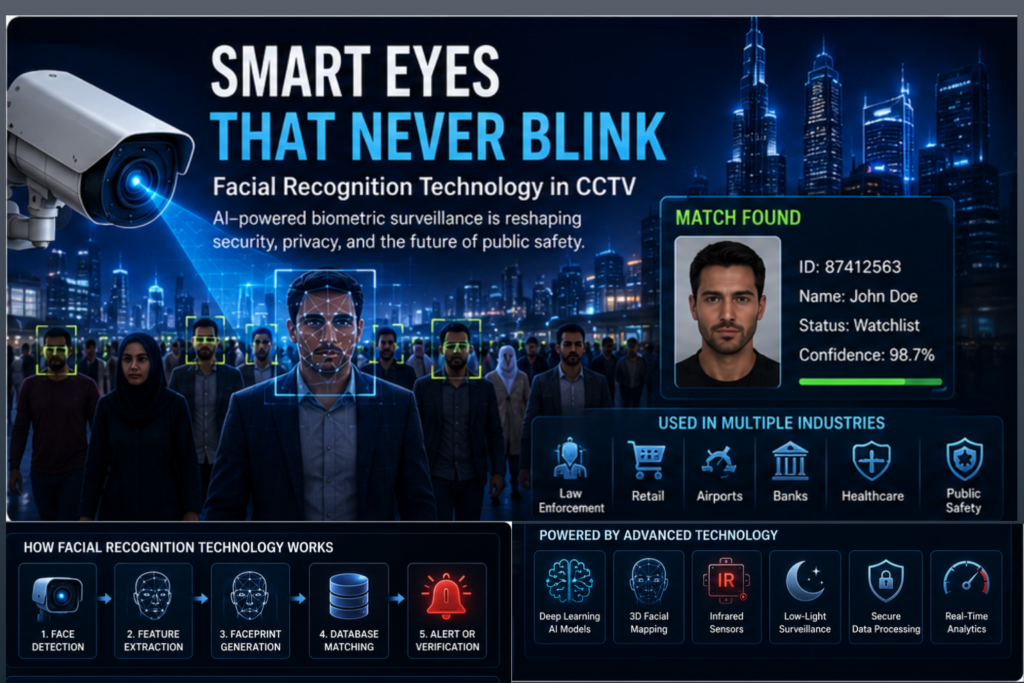
▸ Key Technical Pipeline
Face Detection → Feature Extraction → Faceprint Generation → Database Matching → Alert or Verification
Key Benefits of Facial Recognition in CCTV Security
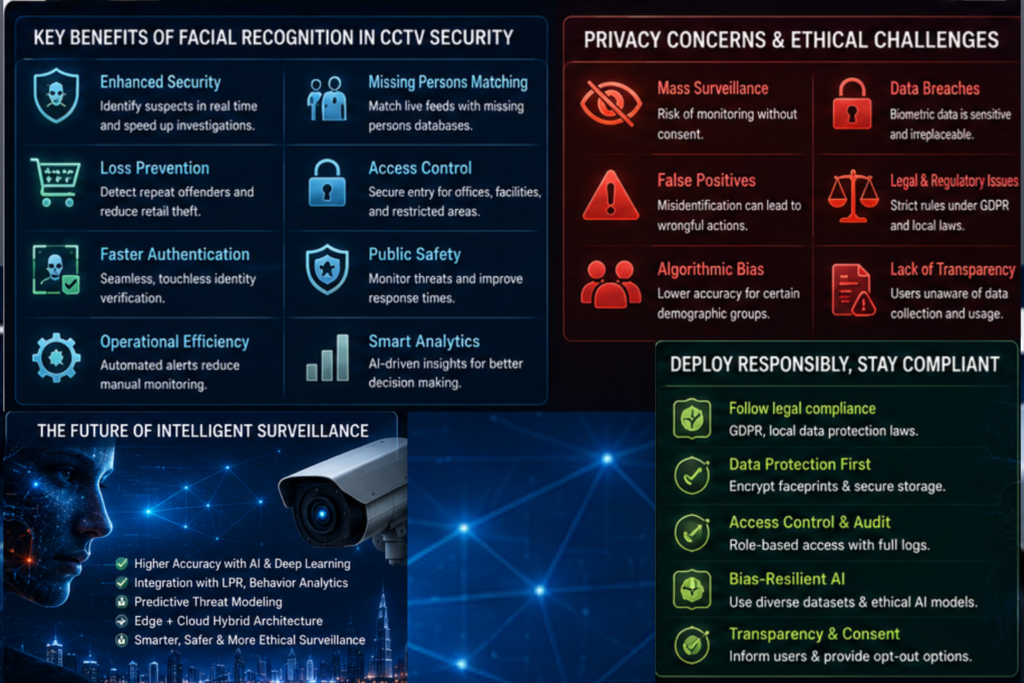
Enhanced security is the most cited advantage. Law enforcement agencies use facial recognition cameras to identify suspects from live or recorded footage, dramatically shortening investigation timelines. In retail, integrating face recognition with existing CCTV helps identify repeat shoplifters, enabling loss prevention teams to act before theft occurs — functioning as both a deterrent and a cataloguing tool.
In high-footfall environments like airports, border control, and banking institutions, biometric authentication via facial recognition reduces fraud while accelerating identity verification. The technology also supports missing persons identification, matching live feeds against databases of missing individuals — a use case with real humanitarian value.
▸ Top Application Areas
Law Enforcement Retail Loss Prevention Airport Security Border Control Healthcare Identity Smart Home Devices Access Control Public Safety
Each domain leverages AI-driven surveillance differently, but the common thread is non-intrusive authentication — seamless verification without physical contact or manual checks.
Privacy Concerns and Ethical Challenges
Privacy concerns remain the loudest objection to facial recognition in CCTV. Mass surveillance of public spaces can occur without individual consent, raising serious civil liberties questions. Critics argue that constant biometric monitoring suppresses the right to free movement and expression — effectively treating every person as a suspect by default.
False positives — misidentifying an innocent person as a suspect — have already led to wrongful detentions. Algorithmic bias compounds this; many AI models trained on non-diverse datasets exhibit lower accuracy for women and people with darker skin tones. Facial recognition databases are also high-value cybersecurity targets — if biometric data is compromised, unlike a password, it cannot be reset.
In retail, companies have faced legal complaints and regulatory scrutiny for deploying FRT CCTV without adequate transparency. GDPR and regional data protection laws require explicit justification for processing biometric information — a bar many deployments fail to meet.
How to Deploy Facial Recognition CCTV Responsibly
Responsible deployment begins with legal compliance. Organizations must align with GDPR, local data privacy regulations, and sector-specific guidelines before installing any biometric surveillance system — including conducting a Data Protection Impact Assessment (DPIA) and publishing a clear transparency notice for those being monitored.
Encryption and secure storage of biometric templates are non-negotiable — faceprints must be stored as encrypted mathematical representations, never as raw images. Access to the watchlist database should be role-restricted with full audit trails. Choosing vendors that actively reduce bias in AI models is equally critical for ethical and legal defensibility.
Finally, user consent frameworks and opt-out mechanisms demonstrate accountability. Organizations that prioritize transparency upfront face far fewer regulatory challenges downstream — a pattern consistently seen in real-world deployments.
The Future of Facial Recognition in CCTV Surveillance
AI and deep learning continue to push accuracy rates upward. Leading facial recognition algorithms now achieve near-perfect accuracy under controlled conditions, and the gap in performance across demographic groups is narrowing. Expect integration with license plate recognition, behavioral analytics, and predictive threat modeling to become standard in next-generation intelligent CCTV platforms.
Smart surveillance systems of the future will blend facial recognition with object detection — identifying both who is present and what they’re carrying. This layered approach improves detection accuracy while offering greater privacy protection compared to facial recognition alone. Regulatory frameworks like the EU’s AI Act already classify real-time biometric surveillance as high-risk — organizations investing now in ethical AI deployment practices will be far better positioned when compliance requirements tighten.
Frequently Asked Questions
Q1. What is facial recognition technology in CCTV?
Facial recognition in CCTV is a biometric surveillance method that uses AI-powered cameras to detect, map, and identify human faces in real time by comparing them against a watchlist database or known-person registry.
Q2. How accurate is facial recognition in CCTV cameras?
Top-tier systems achieve very high recognition accuracy under good lighting and camera angle conditions. However, accuracy drops in poor lighting or when algorithmic bias is present due to non-diverse training data.
Q3. Is facial recognition in CCTV legal?
Legality varies by region. In the EU, GDPR and the AI Act impose strict conditions on biometric surveillance. In the UAE, organizations must align with local data protection regulations. Always conduct a DPIA before deployment.
Q4. What are the privacy risks of facial recognition cameras?
Key risks include mass surveillance without consent, data breaches exposing irreplaceable biometric data, false positives causing misidentification, and algorithmic bias producing discriminatory outcomes for certain demographic groups.
Q5. Where can I find CCTV solutions with facial recognition in the UAE?
For enterprise-grade intelligent CCTV with facial recognition technology in the UAE and MENA region, ITSolus delivers tailored AI-powered security solutions built around compliance, accuracy, and scalability.