
Why Your Surveillance System Is a Hacker’s Favorite Target
Most people assume surveillance systems protect against threats. Few realize the system itself is a threat if left unprotected. Internet-connected cameras and DVR, NVR, and VMS devices create attack vectors that rival traditional IT infrastructure. Cyber-attacks don’t just target offices — they exploit physical security blind spots. Liabilities from breaches are growing, and integrators must treat video surveillance with the same rigor as enterprise networks. A cybersecurity-first approach is no longer optional.
The Anatomy of a Compromised Camera Network
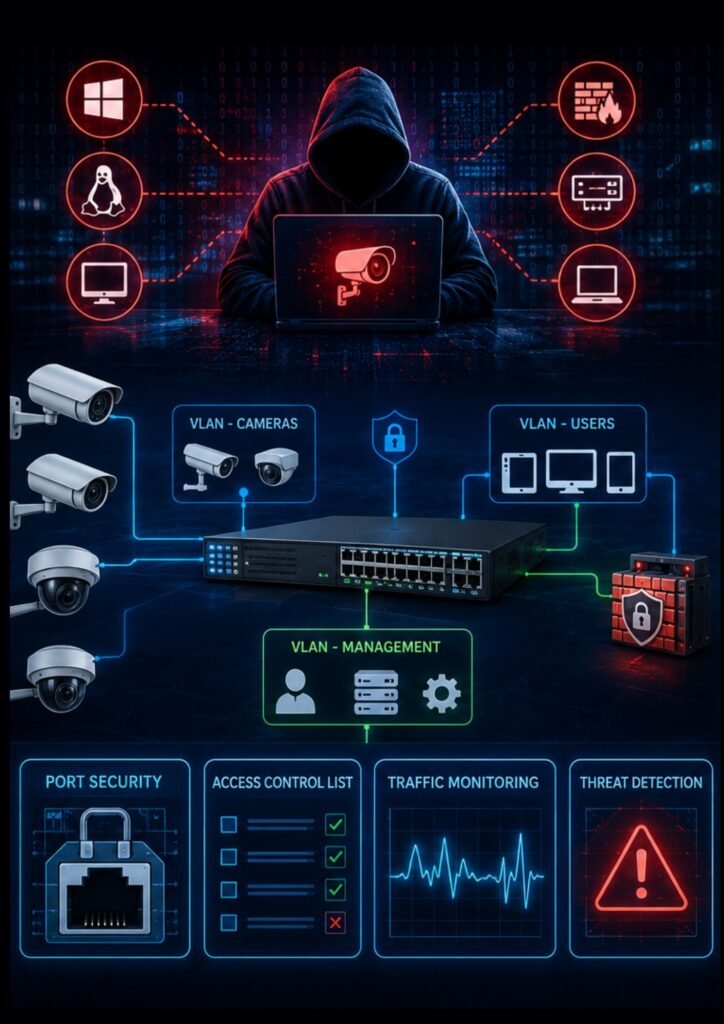
An abstracted video network breaks into two pillars: Technology and Organization. When either is weak, the entire system collapses. Attackers entering at the network level can disrupt or spy on the whole infrastructure. Windows OS, Linux OS, endpoints, and firewall ports are the five primary cyber-attack entry points. Linux vulnerabilities like Shellshock (2014) and Ghost (2015) compromised millions of systems overnight — and many NVR vendors never pushed timely patches. The threat is structural, not incidental.
Network Segmentation: The First Line of Defense
IP switches with management function are not decorative. They are active protection instruments. Placing cameras in a dedicated VLAN separates video users from network administrators, reducing lateral movement if one segment is breached. Without physical separation or VLAN isolation, your surveillance system becomes a doorway into your main network. Certificates and encryption on internal network management communication add another barrier. Planners and installers must keep current through training — technologies change faster than most deployment cycles. Learn more about network security solutions.
Port Security: Closing the Doorways Attackers Love
Every port on an IP switch is a potential entry point. Traffic monitoring and packet inspection can detect deviations from authorized protocols. When manipulation is detected, built-in mechanisms trigger shutdown or restrict network traffic. Access control lists define exactly which data packets pass. Proper parameterization requires both specialist knowledge and clear planning-phase specifications. Isolation of devices and applications at the port level reduces attack surface significantly — especially in systems with cameras at publicly accessible locations.
Password Hygiene: A Crisis Hidden in Plain Sight
In 2014, 73,011 locations with IP cameras across 256 countries were exposed via a single website — the cause? Default passwords never changed. 1 in 5 users still use easy-to-hack credentials. All cameras include a web-based GUI with a published default username. On public networks, every camera should have a unique password. On a VLAN or physically private network, a single strong password across all cameras is acceptable. OS passwords and system passwords follow the same logic — root administrator credentials must be rotated every time an employee with password access leaves or changes roles. Credential management is non-negotiable in 2026.
Firewalls, Port Forwarding, and the 10,000-Scan Reality
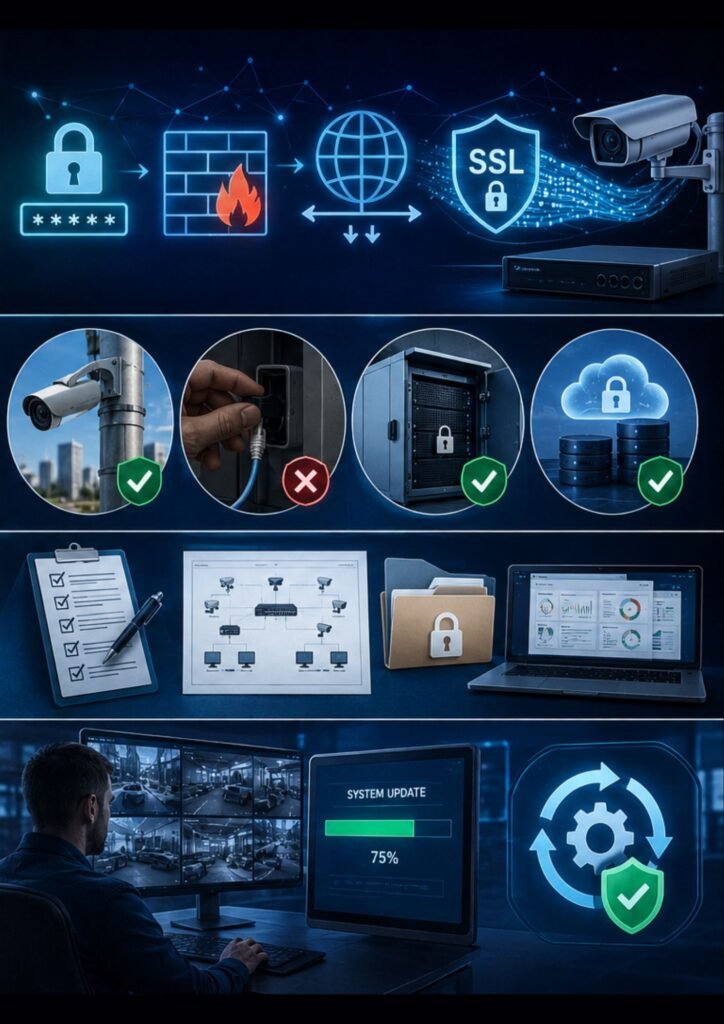
Machines exposed to the internet receive over 10,000 scans per day. Exposing a DVR or NVR via port forwarding for remote access means placing an HTTP server directly in that crossfire. The Heartbleed OpenSSL exploit of 2014 forced mass password resets across thousands of surveillance deployments. Next-generation firewalls analyze protocols at the port level — not just traffic volume. If exposure is unavoidable, limit forwarded ports to the absolute minimum and deploy IDS/IPS alongside. Cloud-based systems that eliminate port forwarding remove this vulnerability class entirely.
Encryption: Protecting Video Both at Rest and in Motion
A system that streams unencrypted video is equivalent to banking without HTTPS. Eavesdropping, privacy breaches, and password vulnerability follow immediately. SSL encryption must protect both the connection and the stored data. Video encryption on disk storage and in transit is the benchmark for a truly secure system. Many cloud vendors offer variable encryption standards — verify specifics before committing to any provider. On mobile, the same rules apply: encrypted connections for iPhone and Android apps to the VMS are mandatory, not optional. Explore encryption best practices.
Physical Access: The Overlooked Cybersecurity Gap
Physical security does not begin in the server room — it begins at every camera mounting point. Systems where cameras are labeled with their IP address and MAC address externally, or connected to open network sockets, invite attackers to unplug the camera and insert a rogue device. Smash and dash theft of on-site DVR/NVR recordings is equally damaging. Secure your cabinets, cables, and the rooms housing video storage servers and switches. Cloud recording mitigates theft of local footage, but the physical layer must still be hardened.
Planning, Documentation, and Standardized Processes
A video network without a documented security plan is an accident waiting to happen. Planning must define measurable goals: what the video network is protecting, how IP addresses are assigned, how VLANs are classified, and how system expansion with new cameras is handled. Processes for installation, acceptance, administration, and documentation must be standardized and understood by all installers. When a password is created during setup, its form, storage location, authorized access, and rotation schedule must all be pre-defined. Network switches that support data stream diagnosis and performance monitoring simplify ongoing network analysis considerably. Consult our documentation framework.
Video Management Software: The Patch Gap Nobody Talks About
VMS platforms rely on layers beneath the interface — Microsoft database components, libraries, and supporting software that each carry their own vulnerabilities. If these components aren’t updated in sync with security patches, the surface area for exploitation grows silently. Ask your VMS vendor directly: what is their vendor policy for keeping components current? Are regular updates automatic? Being passive here means depending entirely on the vendor to act — a risk no security-conscious operator should accept. Proactive monitoring of known security vulnerabilities in the industry remains the practitioner’s best discipline.