
How to Choose the Right CCTV Camera for Your Home
Introduction
Camera types, resolutions, and brands matter far less than understanding your property. Most homeowners in an apartment, townhouse, or single-family home face an overwhelming market: 2MP entry units, 4K flagships, AI detection, night vision, smart apps, wired cameras, and Wi-Fi systems all competing for attention. An informed decision demands honest real-world capabilities review.
A closed-circuit television system must survive real conditions before protecting your assets and safety. Setup requirements, long-term value, weather resistance, high-quality footage, and reliability determine whether a stable, performing system holds up. PoE IP turret cameras eliminate batteries — matching surveillance needs to home security realities separates lasting protection from regret.
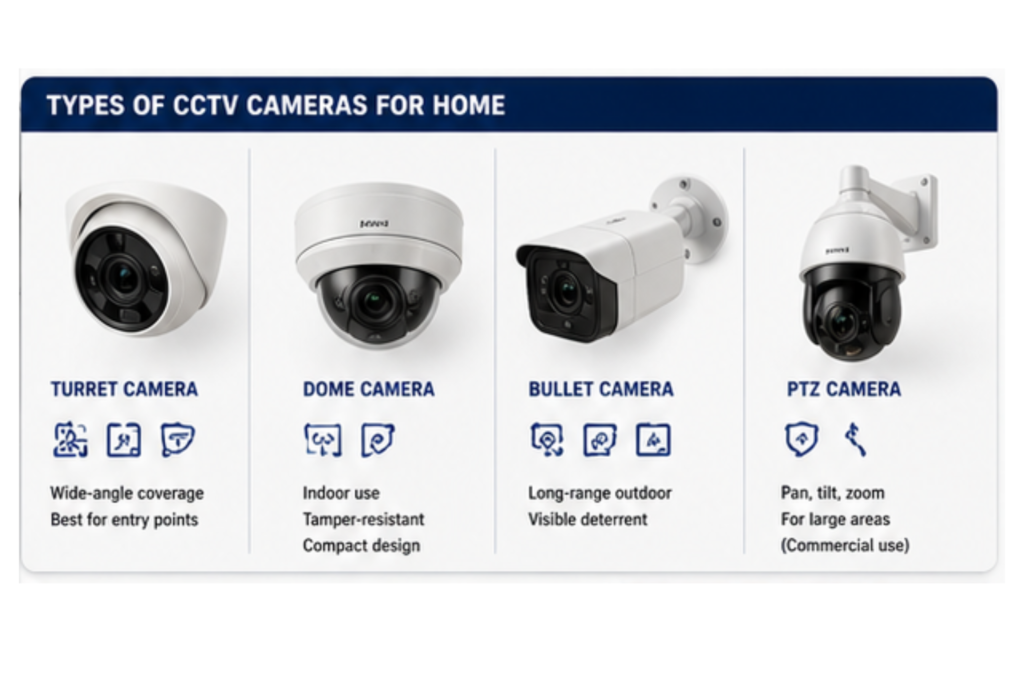
Types of CCTV Cameras for Home
Turret cameras eliminate the infrared reflection degrading dome cameras at night. Mounted on ceiling or walls, their positioning delivers precise wide-angle coverage across entry zones. Dome cameras serve indoor hallways and garages — tamper-resistant compact rounded design blends into architecture, though enclosed housing traps infrared light and hurts nighttime clarity.
Bullet cameras handle outdoor long-range and rural settings — their elongated shape deters intruders, though rain, dust, and spider webs demand routine maintenance. PTZ cameras — pan tilt zoom units — belong on commercial sites and warehouses; moving parts rarely justify home use. Fixed 4MP, 6MP, 8MP, and 4K resolution at side access areas consistently outperform motorized units.
Determine Your Surveillance Needs
A wide-angle lens across a backyard differs entirely from a narrow-angle or panoramic view at a gate. Sound home layout assessment — defining area coverage, surveillance objectives, objectives, and security requirements — must precede installation planning. Map monitoring area and monitoring areas against surveillance needs in your property assessment before comparing any products.
Indoor cameras and outdoor cameras are not interchangeable. Weatherproof housing, temperatures tolerance, and seasonal weather conditions matter. A specific purpose mismatch causes degradation within one season. Day/night capability is baseline — without it, properties remain exposed during daytime gaps and every nighttime conditions window when incidents peak.
Camera Resolution and Image Quality
Resolution without correct placement produces sharp images of nothing useful. Whether footage clarity, objects, and activities are captured with actionable recording clarity under real-world conditions is the real measure — pixel density alone guarantees nothing. 4MP is the outdoor floor for face identification and number plate capture. 1080p / Full HD covers general coverage indoors adequately. Ultra HD and high-detail areas — gates, driveways — justify the investment where vehicle identification is a priority. Running 8MP inside low-risk hallways wastes bandwidth, storage, and budget without returning proportional image quality.
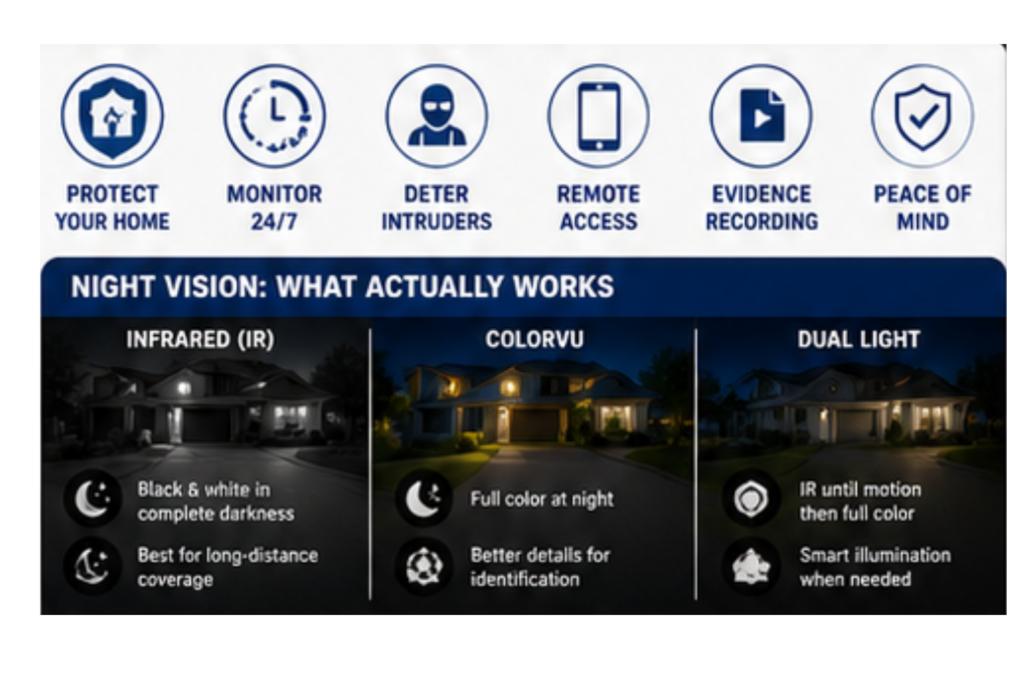
Night Vision: What Actually Works
Most night vision failures trace to placement, not hardware. An infrared lens aimed at a reflective surface produces IR glare regardless of camera grade — especially across driveways and backyards. ColorVu and Dual Light systems push visible-spectrum supplemental LEDs, producing full color footage for people identification across outdoor areas during night-time incidents. Standard Infrared IR delivers black and white footage in complete darkness with genuine round-the-clock surveillance reach — strongest for long-distance coverage after dark. Dome cameras fail structurally at night because enclosed housing defeats what high-sensitivity image sensors and lens separation achieve in turret designs — consistently clearer images when it matters most.
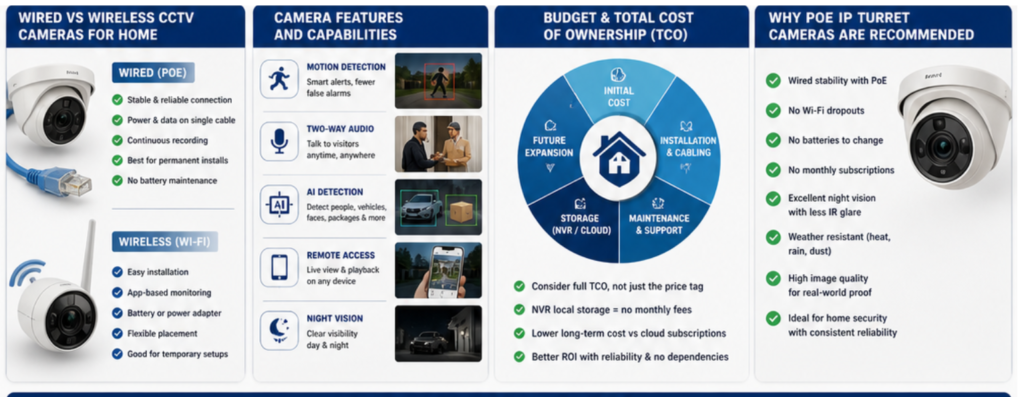
Wired vs Wireless CCTV Cameras for Home
Wi-Fi dropouts expose wireless systems at the worst moments. Stable connections, uninterrupted recording, high-quality video, and serious protection are structural outcomes of wired infrastructure — not software improvements. PoE — Power over Ethernet — carries power and data via a single cable, integrating cleanly into surveillance infrastructure built for software compatibility across apps and devices. AC power works; PoE is the cleanest permanent path. Wireless cameras offer app-based monitoring, battery-powered flexibility, and flexible installation for renters and temporary setups — but silent battery maintenance failures remove coverage without any visible alert.
Camera Features and Capabilities
Poorly tuned motion detection trains users to ignore alerts entirely — a recording trigger that cannot separate real people detection from ambient movement floods storage space with noise, burying critical recorded footage. Two-way audio enables real-time communication with visitors and family members via smartphone, tablet, or computer — anywhere, anytime — converting passive surveillance into active response capability. AI detection using artificial intelligence — supporting face recognition, package detection, distinguishing pets from vehicles — shifts security from reactive to anticipatory. Smart app live viewing, camera settings access, infrared LEDs, night vision, performance, functionality, and user experience converge when hardware and software operate as one system.
Budget and Total Cost of Ownership (TCO)
Purchase price is the smallest component of the real budget. Setup, cabling, maintenance, support, and future expansions define actual spend. Cost-effective decisions require full TCO visibility — not a box-price comparison. NVR local storage eliminates monthly subscription fees — avoiding recurring cost versus cloud-based plans starting at $4.99 per month makes the initial cost of wired infrastructure lower in total than it initially appears. Honest ROI reveals real value: long-term residential use, insurance reductions, zero subscription dependency, and sustained performance earn a budget allocation that no single purchase price comparison can capture accurately.
Why PoE IP Turret Cameras Are Recommended
PoE IP turret cameras eliminate every variable behind silent failure — no WiFi dropouts, no dead batteries, no lapsed subscriptions. A wired connection via PoE connection on a single cable makes consistent delivery the default. NVR systems for secure local recording eliminate third-party dependency with no monthly subscription fees — image quality under real outdoor conditions meets evidentiary standards. Excellent night vision with reduced infrared glare through lens separation keeps dark-hour footage usable. Weather resistant housings for heat, rain, and dust sustain performance where wireless fails. Stable performance, face identification, and number plate legibility define why professional residential installation defaults here — consistent reliability is the specification.
FAQ: What type of CCTV camera is best for home use?
For most residential homes, PoE IP turret cameras deliver stable performance, no Wi-Fi dependency, true weather resistance, and night vision for real conditions. Image quality sufficient for face identification makes them the best choice. Systems relying on batteries introduce maintenance gaps wired architecture eliminates from home use.
FAQ: What resolution CCTV camera should I buy?
Use 4MP outdoors for face identification and number plate capture. 1080p — Full HD — is the minimum resolution recommended for any install. 2MP covers low-risk interiors. For driveways, entrances, and high-detail areas, 4K earns its storage cost. Ultra HD at 8MP belongs at perimeter choke points only.
FAQ: Are wireless CCTV cameras good for homes?
Easy installation and app convenience make wireless valid for renters and short-term setups. For permanent installation, Wi-Fi dropouts and battery maintenance create real coverage gaps. Wired PoE cameras remove those variables structurally. Choose wireless for convenience; choose wired where outdoor reliability is non-negotiable.
FAQ: Do CCTV cameras work at night?
Infrared IR delivers black and white footage in complete darkness — strongest for low-light distance. Colorful and Dual Light use supplemental LEDs and high-sensitivity sensors for colour. Both achieve solid night performance. Choose IR for range; choose Dual Light where color identification matters most.
FAQ: Do I need a subscription for home CCTV cameras?
NVR-based wired systems store locally — no subscription cost after hardware purchase. Cloud-based cameras require ongoing video storage and advanced features plans. The recurring cost over five years typically exceeds the hardware difference — full payment timeline reveals actual cost.
FAQ: What is the difference between dome and bullet cameras?
Dome cameras provide discreet, tamper-resistant coverage for indoor and sheltered zones. Bullet cameras deliver long-distance monitoring along outdoor surveillance perimeters as active deterrents. Choose dome for discretion and anti-tamper; choose bullet when camera visibility itself is part of the security strategy.
FAQ: What should I consider when buying a home CCTV camera?
Every buying decision must sequence: define surveillance area first, then resolution, night vision, wired vs wireless connectivity, power source, motion detection, remote access, storage type — NVR vs cloud — then full total cost of ownership. These key factors are interdependent — surveillance area shapes every downstream choice.